Quick Summary:
A nut runner, pneumatic impact wrench and pulse tool are industrial fastening tools with different torque delivery mechanisms and tightening capabilities.
- Nut runner: Supports controlled tightening through clutch mechanisms, automatic shut-off or electronic torque control, depending on the model.
- Pneumatic impact wrench: Uses mechanical impacts to deliver high torque for demanding fastening applications and fastener removal.
- Pulse tool: Uses hydraulic pulses to transfer torque while reducing reaction force transmitted to the operator compared with conventional impact mechanisms.
- Accuracy: Depends on the tool’s control system, joint characteristics, friction, operating conditions and verification method.
- Joint protection: Correct torque settings, fastener alignment and appropriate process controls help reduce the risk of over-tightening, under-tightening and cross-threading.
Tool selection depends on the joint specification, torque requirements, production rate, operator handling and required level of process monitoring.
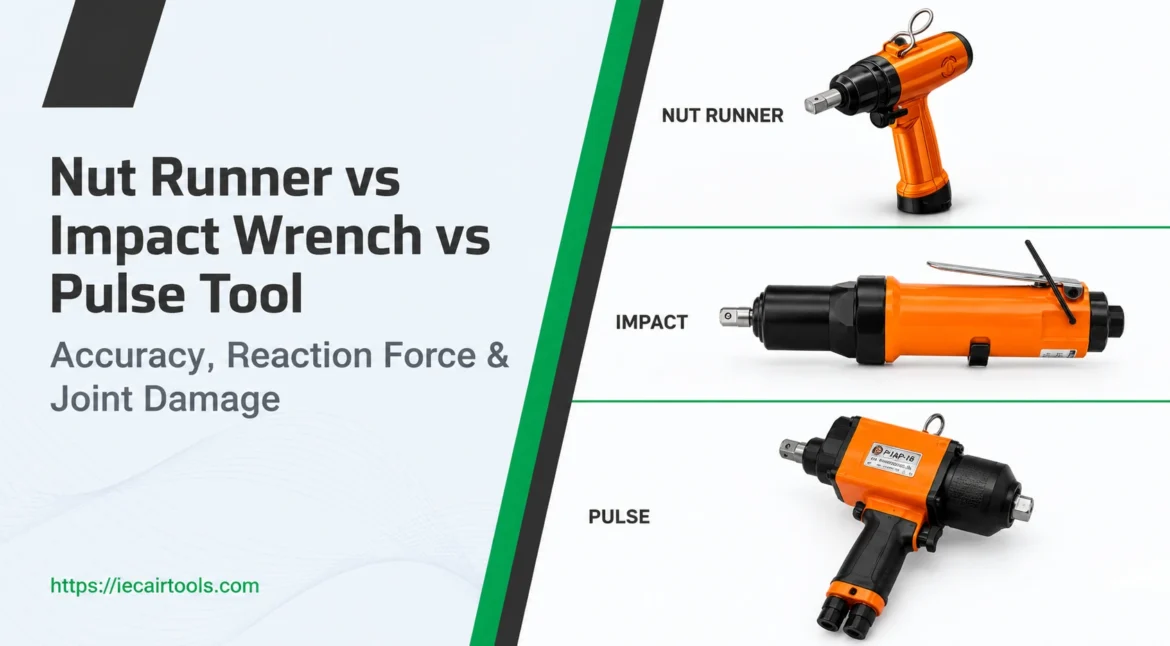
Nut Runner vs Impact Wrench vs Pulse Tool: Accuracy, Reaction Force and Joint Damage
Every bolted joint has a defined tightening requirement, and the tool used to achieve it influences the quality of the final assembly. Torque delivery, joint stiffness, friction and reaction force all contribute to the outcome. Selecting a tool based solely on its torque rating can overlook factors that affect fastening consistency and component integrity.
Nut runners, pneumatic impact wrenches and pulse tools address these requirements through different mechanisms. Understanding how each technology performs helps manufacturers match their fastening equipment to the demands of the application.
Understanding the Three Fastening Technologies
Although nut runners, pneumatic impact wrenches and pulse tools all tighten threaded fasteners, they differ in how they deliver torque and manage the tightening process. These differences influence their suitability for specific joint types, production speeds and quality requirements.
Nut Runner: Controlled Tightening for Assembly Operations
A nut runner is designed to tighten nuts and bolts in industrial assembly. Depending on the model, it may use a mechanical clutch, automatic shut-off or electronic torque control to manage the tightening operation.
The choice of control mechanism determines how the tool responds when the required tightening endpoint is reached. Basic models can support repeatable fastening through mechanical control, while transducerised systems can measure torque and record the results of individual cycles.
Nut runners are commonly used in automotive assembly, machinery manufacturing and equipment production, where fastening specifications must be maintained across repeated operations. Selection depends on the required torque range, joint characteristics, access constraints and the level of process monitoring needed.
For applications requiring controlled tightening, IEC Air Tools brings you Automatic Shut-Off Screwdrivers and Nut Runners, available in straight, pistol and angled configurations. These tools use automatic shut-off mechanisms to stop the drive when the configured tightening endpoint is reached.
Pneumatic Impact Wrench: Rapid Rundown and High Torque
A pneumatic impact wrench uses compressed air to power a motor connected to a hammer-and-anvil mechanism. As the mechanism rotates, it delivers successive impacts to the output spindle, generating torque to tighten or loosen threaded fasteners.
This operating principle makes the impact wrench suitable for applications that require rapid rundown, high torque output or frequent fastener removal. Depending on the model and its torque capacity, it can be used in automotive manufacturing, heavy equipment assembly, machinery maintenance and other demanding industrial operations.
IEC Air Tools offers a range of pneumatic impact wrenches, including its N Series Lightweight Impact Wrenches and + Series Lightweight Impact Wrenches. These ranges address different fastening requirements while considering tool weight, handling and durability.
The main selection factors include the required torque range, drive size, fastener dimensions, available air pressure and frequency of use. Tool weight and grip design also influence handling during repetitive operations.
Torque delivery requires particular attention in precision assembly. An air regulator can adjust the tool’s operating conditions, but it does not directly measure the final torque applied to the joint. The result can vary with joint stiffness, friction, air pressure and operating technique. Where a fastening specification demands verified torque results, the process should incorporate a suitable control or inspection method.
The impact wrench is therefore most appropriate when its torque capacity and operating characteristics match the application, with additional verification where joint quality requirements call for it.
Pulse Tool: Hydraulic Torque Delivery with Reduced Reaction Force
A pulse tool uses a hydraulic pulse mechanism to transfer torque to the fastener. In a pneumatic oil pulse tool, compressed air drives the motor, which powers the hydraulic unit to deliver successive torque pulses. This mechanism differs from the mechanical hammer-and-anvil action of a conventional impact wrench.
The hydraulic pulse mechanism is designed to reduce reaction torque, noise and vibration transmitted to the operator. These characteristics make pulse tools suitable for repetitive fastening operations where handling comfort and consistent production cycles are important.
IEC Air Tools offers the Accura Oil Pulse Wrenches, which feature a hydraulic pulse mechanism and a double-chamber air motor. The range covers different torque requirements, allowing manufacturers to select models according to fastener size, joint specifications and production needs.
For applications requiring automatic shut-off, the Accura Oil Pulse Shut-Off Wrenches combine hydraulic pulse technology with a mechanism that stops the tool when its configured tightening endpoint is reached. Where measured torque and electronic process validation are required, the Accura FT Series Transducerised Pulse Tools provide an integrated rotary strain-gauge transducer and support monitoring through the CMS FT-V2 controller.
These configurations serve different levels of process control. A standard pulse tool provides adjustable torque, a shut-off model adds automatic stopping, and a transducerised system adds torque measurement and electronic validation.
Tool selection should account for the target torque, joint stiffness, available air pressure, cycle time and required quality checks. Matching these factors to the tool’s capabilities helps manufacturers establish a fastening process that supports both operator handling and joint integrity.
Reaction Force: What the Operator Experiences During Tightening
Reaction force affects how a fastening tool behaves in the operator’s hands. During tightening, the tool generates a counterforce that the operator must manage while maintaining alignment and control. The level of reaction depends on the tool mechanism, applied torque, joint characteristics and operating conditions.
A pneumatic impact wrench generates torque through successive mechanical impacts. These impacts can produce noticeable reaction, vibration and noise, particularly during demanding fastening operations. Tool weight, handle design and operating technique also influence how manageable the tool feels during repeated cycles.
Compared with conventional impact mechanisms, pulse tools can reduce reaction force transmitted to the operator. This makes them useful for repetitive assembly applications where operators perform frequent tightening cycles throughout a shift.
A nut runner’s reaction characteristics depend on its drive mechanism and torque output. Mechanical clutch systems, automatic shut-off mechanisms and electronic controls influence how the tool behaves as it reaches the tightening endpoint. The overall setup, including tool weight, grip and access to the fastener, remains important when assessing operator handling.
For manufacturers, tool selection should account for both the fastening requirement and the demands placed on the operator. IEC Air Tools’ Accura Oil Pulse range is designed for applications where reduced reaction force, lower vibration and manageable handling are important considerations. The appropriate model should be selected according to the required torque, duty cycle and working environment.
Joint Damage: How Tool Selection Affects Fastener Integrity
Fastening problems can arise when tightening generates excessive stress, leaves the joint with insufficient clamping force or introduces mechanical errors during assembly. The fastening tool influences how torque is delivered, while fastener specifications, component design and assembly procedures determine the acceptable tightening conditions.
Over-Tightening and Under-Tightening
Excessive torque can stretch a bolt beyond its intended limits, damage threads or deform mating components. Insufficient tightening can leave the joint with inadequate clamping force, increasing the risk of loosening, leakage or component movement.
A nut runner with a suitable shut-off or clutch mechanism helps control the tightening endpoint. A pulse tool with appropriate torque adjustment or automatic shut-off can support the same requirement. An impact wrench can deliver the torque needed for demanding applications, but critical assemblies may require a controlled final-tightening procedure or a validated method of verification.
Cross-Threading and Misalignment
Cross-threading occurs when a fastener engages the threads incorrectly, often because it enters at an angle or encounters resistance during initial engagement. Continuing to tighten can damage the bolt and the threaded hole.
Correct alignment and controlled fastener engagement are essential, regardless of the tool selected. Production systems that include electronic monitoring can provide additional checks for certain assembly errors. IEC Air Tools’ Accura FT Series Transducerised Pulse Tools support features such as cross-thread detection and cycle OK/NOK monitoring when used with the specified controller.
Inconsistent Tightening Across Production Cycles
Variations in lubrication, surface finish, component tolerances and joint stiffness can change the relationship between applied torque and clamp load. A tool that performs consistently under one set of conditions may produce different results when these variables change.
Manufacturers should establish tightening specifications, define acceptable results and investigate failed cycles before corrective action. Repeatedly applying torque to a joint without identifying the cause of the failure can increase the risk of fastener damage.
Choosing the Right Tool for the Application
Tool selection starts with the demands of the fastening operation. Torque requirements, production volume and the level of tightening control needed help determine which technology is best suited to the job.
| Application need | Tool to consider | Key consideration |
| Controlled assembly tightening | Nut runner | Repeatability and shut-off requirements |
| High-torque fastening or fastener removal | Pneumatic impact wrench | Torque capacity and final-tightening control |
| Repetitive fastening with reduced reaction force | Pulse tool | Cycle frequency and operator handling |
| Recorded torque results | Transducerised nut runner or pulse tool | Measurement and process validation |
The final selection should account for the joint specification and the required level of quality assurance. Where tightening results must be documented, choose a configuration that supports the necessary measurement, monitoring and verification processes.
Matching Fastening Tools to Joint Requirements
The right fastening tool brings together joint requirements, tightening control and production needs. By matching these factors to the capabilities of each tool, manufacturers can improve fastening consistency while protecting joint integrity. IEC Air Tools offers solutions to support these requirements across industrial assembly applications.
Frequently Asked Questions
1. What is the difference between a nut runner and an impact wrench?
A nut runner is commonly used for controlled tightening in assembly operations, with control options such as clutch mechanisms, automatic shut-off or electronic torque measurement. A pneumatic impact wrench uses successive mechanical impacts to deliver torque, making it suitable for high-torque applications and fastener removal.
2. Is a pulse tool more accurate than an impact wrench?
Accuracy depends on the tool configuration, joint characteristics and operating conditions. A pulse tool can offer automatic shut-off or torque measurement in suitable configurations, while a conventional impact wrench may require a separate method to verify the final tightening result.
3. How does a pulse tool reduce reaction force?
A pneumatic oil pulse tool uses a hydraulic mechanism to deliver torque in pulses. This reduces the reaction force transmitted to the operator compared with conventional impact mechanisms, making pulse tools useful for repetitive assembly operations.
4. Can a nut runner prevent over-tightening?
A nut runner equipped with a suitable clutch or automatic shut-off mechanism can help control the tightening endpoint. Transducerised models can also measure torque and support validation against defined acceptance limits. Correct setup and process verification remain essential.
5. Which fastening tool is best for repetitive assembly work?
The choice depends on the required torque, joint characteristics, cycle frequency and operator handling requirements. A nut runner may suit applications requiring controlled tightening, while a pulse tool may be appropriate when reduced reaction force is a priority. The specific model should match the assembly requirements.
6. Why is torque measurement important in industrial fastening?
Torque measurement helps manufacturers assess whether tightening results meet specified requirements. When combined with suitable process monitoring, acceptance limits and cycle records, it can support quality checks, traceability and the investigation of fastening failures.