In high-volume manufacturing, processes are designed for consistency. Parts move from machining to coating to assembly with the expectation that each stage delivers predictable results. But in reality, components don’t always arrive in perfect condition.
Coatings enter threaded holes. Welding introduces slight distortion. Handling and transport may cause minor damage or debris. None of these issues are severe enough to stop production immediately, but they are enough to disrupt fastening when it matters.
What follows is not a process failure, but a deviation. And how that deviation is handled determines whether the line keeps moving or slows down. This is where air tapping takes on a role that is often overlooked.
When Usability Varies on the Line
Threaded features are rarely the focus of attention during assembly, but their condition can influence how smoothly operations progress. In many production environments, it is common for threaded interfaces to require minor preparation before fastening, due to changes introduced by upstream processes and handling.
In these situations, the thread has been created as intended, but may not always be immediately ready for use at the point of assembly. For operators, this typically appears as:
- Fasteners requiring additional alignment before engagement
- Slight variations in engagement time across cycles
- The need for controlled handling to maintain consistency
When managed within the process, these variations can be addressed without interrupting overall assembly flow.
How Thread Recovery Is Typically Approached on the Line
In many assembly environments, variations in thread condition are addressed as they appear, rather than through a defined process step. Common approaches include:
- Manual cleaning or adjustment before fastening
- Re-attempting engagement until alignment is achieved
- Moving parts to separate correction areas when required
While these methods allow production to continue, they often depend on operator judgement and can vary across shifts and stations. This is where thread retapping becomes more relevant as a structured way to restore thread usability within the assembly process itself.
The Role of Air Tapping Tools in Production Recovery
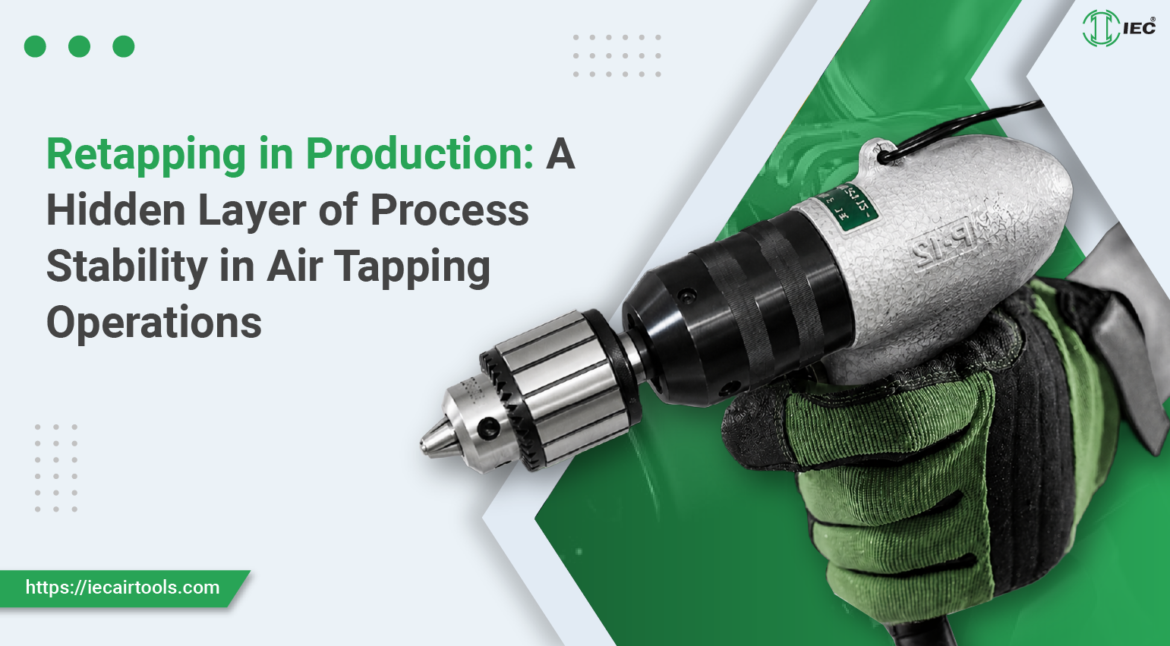
This is where a controlled approach becomes necessary. A pneumatic tapping tool used for recovery is not part of the primary machining process. Instead, it serves as a line-side solution for restoring thread usability. In practical terms, tools such as an industrial air tapper are used to:
- Clear paint, rust, or coating residue from threaded holes
- Correct minor distortions after welding
- Remove debris that prevents proper engagement
- Restore threads quickly without removing parts from the line
Unlike manual methods, a tapping gun provides consistent rotation and control, allowing operators to perform these corrections efficiently and repeatably. The goal is not to recreate the thread, but to make it usable again, quickly and reliably. In such applications, tools like the IEC Air Tapper are used to restore thread usability at the point of assembly without interrupting production flow.
IEC Air Tapper – Feature Highlight |
|
| Feature | Why It Matters in Production |
| Double Trigger (Forward/Reverse Control) | Enables quick switching between tapping and reverse, allowing operators to clean and restore threads efficiently at the point of use. |
Where Air Tappers Fit in the Assembly Environment
These tools are typically not placed in primary machining stations. Instead, they appear where real-world conditions demand flexibility:
- Rework or correction stations
- Line-side support areas
- Pre-assembly preparation zones
- Maintenance and fixture handling areas
In these locations, the focus is on keeping parts moving. By enabling quick recovery at the point of need, air tapping tools help avoid unnecessary delays, reduce part rejection, and maintain overall process continuity.
Stability Is Built in the Exceptions
Assembly lines are designed around standard processes, but real performance is defined by how exceptions are handled. Thread obstructions are part of everyday production conditions. Ignoring them or handling them inconsistently introduces variability that affects both throughput and quality.
By enabling controlled thread retapping at the point of use, air tapping tools help restore usability without disrupting flow. In this sense, they are not just tools for correction, but for maintaining continuity.