Consistent tools support consistent assembly, and consistent assembly defines product reliability.
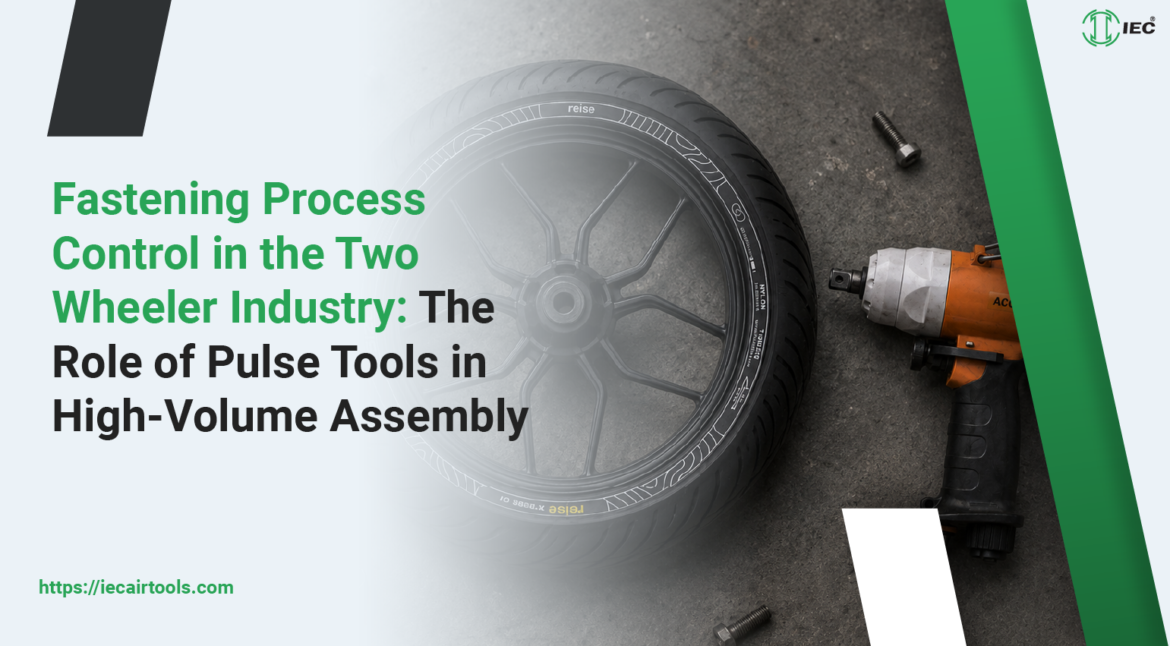
The two wheeler industry operates on speed, precision, and repetition. Across a modern automotive assembly line, fastening is performed continuously (often hundreds of times per shift) under varying production conditions. Within this manufacturing assembly process, achieving a target torque is only one part of the equation. What defines performance is how consistently fastening behaves across cycles, shifts, and stations.
Assembly Reality in the Two Wheeler Industry
In two wheeler assembly, fastening is not a one-time activity. It is a repeated operation across:
- Engine and powertrain systems
- Chassis and structural components
- Wheel and suspension assemblies
Each of these areas involves high volume assembly, where tools are expected to deliver uniform results across extended production runs. This makes fastening consistency a core requirement. And that is not just at the start of production, but throughout the entire cycle of operation.
Where Fastening Consistency Matters Most
Not all joints behave the same way. In practice, fastening performance is influenced by application context:
- Engine assemblies demand repeatable clamp load for performance and safety
- Chassis fastening requires structural stability across dynamic loads
- Wheel and suspension systems depend on reliable tightening under variable conditions
In each case, consistency is not defined by a single tightening event, but by how the process performs repeatedly under real conditions.
How Fastening Behaviour Changes During Production
Even in a stable setup, fastening behaviour evolves during continuous operation. Factors such as air supply variation, tool usage over time, and environmental conditions influence how torque is delivered. These influences do not cause abrupt changes. Instead, they gradually affect:
- Tool response during tightening
- Speed and pattern of torque buildup
- Interaction between tool output and joint condition
At an individual level, each cycle may still appear acceptable. However, across a high volume assembly environment, these small differences begin to form patterns. This is where torque drift and torque variation in assembly become relevant as gradual shifts in process behaviour.
What Final Torque Alone Does Not Reveal
In many cases, fastening evaluation focuses on whether the final torque value meets the specification. While important, this does not fully describe the tightening process. Two cycles can reach the same torque and still differ in outcome.
- One may reach torque quickly due to lower friction
- Another may build torque gradually with better seating
Similarly, early variations in tightening are often absorbed within the joint. Surface interaction, material deformation, and friction can mask these differences, allowing results to remain within limits. Over time, however, these variations accumulate.
This highlights an important distinction: Final torque confirms the result, but not how that result was achieved. Understanding this gap is essential for improving torque accuracy in assembly and overall fastening quality.
Process Control in High-Volume Assembly
In a manufacturing assembly process driven by repetition, process control becomes critical. Rather than evaluating individual tightening cycles in isolation, manufacturers focus on:
- Patterns across repeated cycles
- Behaviour trends over time
- Consistency across stations and shifts
This shift from outcome-based evaluation to behaviour-based monitoring is what defines modern fastening process control. It allows teams to move beyond reactive correction and toward proactive stability.
Role of Transducerised Pulse Tools in Process Control
This is where transducerised pulse tools play a central role. Unlike conventional tools, they measure actual torque output during each tightening cycle. More importantly, they provide cycle-level data, enabling visibility into how fastening behaves over time. This enables:
- Tracking of torque variation across cycles
- Identification of gradual behavioural shifts
- Improved data traceability for fastening
With this level of insight, fastening becomes a measurable and controllable process rather than a series of isolated events. In practical applications, systems such as IEC’s Accura FT transducerised tools are used to support this level of visibility and control within high-volume production environments.
IEC Tool Feature Highlight
Feature Focus: Cycle-Level Data Visibility |
|
| Feature | Relevance to Process Control |
| Cycle-Level Torque Data Capture | Enables monitoring of fastening behaviour across cycles, helping detect gradual torque variation and maintain consistent fastening performance. |
Supporting Role of Shut-Off Pulse Tools
In many automotive assembly line environments, a shut off pulse tool continues to support consistent execution across cycles. Subtle changes in tool behaviour can often act as early indicators that tightening conditions are evolving within the process.
Calibration as a Process Alignment Mechanism
Maintaining consistency over time also requires periodic alignment. Calibration ensures that tool output remains in line with defined performance expectations. In high-volume environments, this is not just a maintenance activity, but a way to confirm that the fastening process continues to operate within controlled limits. This plays a key role in maintaining torque accuracy and supporting long-term process control.
From Output Consistency to Process Confidence
In the two wheeler industry, as production scales, small variations become part of the system. Managing them requires more than meeting torque targets. It requires understanding how fastening behaves over time.
By combining process control, data traceability for fastening, and the capabilities of pulse tools, manufacturers can move toward a more stable and predictable assembly environment. In doing so, fastening shifts from a task to a controlled process—supporting reliability not just on the line, but in the final product as well.