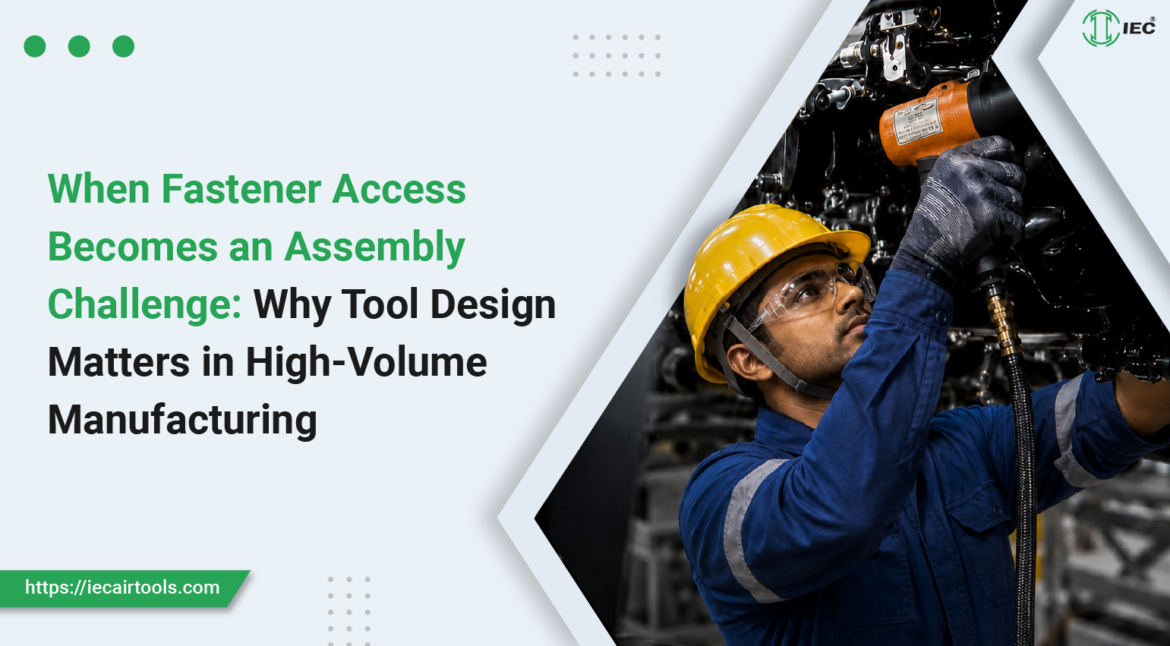
In modern manufacturing, not every fastening operation takes place in an open, easily accessible location. Across automotive, industrial equipment, commercial vehicle, and appliance production, operators often work inside engine compartments, gearbox housings, deep structural frames, and enclosed assemblies where reaching the fastener itself becomes part of the challenge.
While the fastening requirement remains unchanged, the working environment does not. In these applications, the design of industrial tools plays an important role in maintaining manufacturing productivity without compromising fastening consistency across high-volume manufacturing environments.
Not Every Fastening Point Is Easy to Reach
Some fastening points are positioned deep inside assemblies, while others are surrounded by nearby components that restrict access. In many cases, operators have limited visibility of the fastener and less room to position the tool comfortably. These challenges are common across applications such as:
- Engine compartments
- Gearbox housings
- Cross members
- Industrial pumps
- Compressor assemblies
Although the fastening operation may appear straightforward, restricted access often changes how the tool is handled. As production volumes increase, maintaining consistent fastening conditions becomes more challenging when operators must repeatedly work in confined or awkward positions.
Why Restricted Access Creates More Than an Ergonomic Challenge
Restricted access affects more than operator comfort. It can also influence how consistently fastening operations are performed throughout a production shift.
When operators work in awkward positions or with limited visibility, the physical effort required to position and control the tool naturally increases. Over hundreds of fastening cycles, this may contribute to operator fatigue, making it more difficult to maintain process consistency across repetitive operations.
From a manufacturing perspective, these conditions can influence assembly quality and overall manufacturing productivity, particularly in high-volume production where repeatability is essential. This is why industrial ergonomics and well-designed ergonomic tools have become important considerations when selecting fastening equipment for restricted-access applications.
Why Power-to-Weight Ratio Matters in Restricted-Access Assembly
When fastening points are difficult to access, tool weight becomes a part of the assembly process itself. Operators performing repetitive fastening tasks often need to hold the tool at different angles or work inside confined spaces for extended periods. Under these conditions, a favourable power-to-weight ratio helps improve handling by delivering the required fastening performance without unnecessary tool weight.
A well-balanced tool allows operators to maintain better control throughout repetitive production cycles, helping reduce physical effort while supporting manufacturing productivity and improving process consistency over long operating shifts.
Tool Design for Better Accessibility
Restricted-access fastening applications often require more than a standard tool configuration. Tool selection must also consider accessibility, operator handling, and the specific requirements of the assembly. For these applications, IEC Air Tools offers solutions that support fastening performance while improving accessibility where required.
Accura Oil Pulse Wrenches
Designed with a favourable power-to-weight ratio, IEC’s Accura Oil Pulse Wrenches combine controlled fastening performance with low reaction forces and ergonomic handling, making them well suited to repetitive fastening operations in demanding production environments. For applications where fasteners are positioned deeper within assemblies, IEC also offers Extended Anvil Accessories for its Impact Wrench range.
Product Highlights: IEC Oil Pulse Wrench and Impact Wrenches |
|
| Feature | Manufacturing Benefit |
| High Power-to-Weight Ratio | Supports easier handling during repetitive fastening |
| Low Reaction Pulse Technology | Improves operator control |
| Ergonomic Tool Design | Helps support consistent fastening across production |
| Extended Anvil Accessories | Improves access to recessed fastening points without compromising operator handling |
Better Tool Accessibility Supports Better Assembly Performance
Reaching the fastener is only one aspect of the operation; maintaining consistent fastening conditions throughout production is equally important. Thoughtfully designed industrial tools help manufacturers improve assembly efficiency.
In restricted-access applications, improvements in tool design can contribute to more consistent assembly quality while helping manufacturers sustain manufacturing productivity over long production runs. As a result, tool accessibility is increasingly viewed not simply as an ergonomic consideration, but as an important contributor to reliable, repeatable assembly performance.