Not every fastening operation in an engine carries the same level of manufacturing risk. While many joints primarily provide structural support, others play a direct role in maintaining sealing integrity within critical fluid systems.
Oil cooler assemblies are one example. These assemblies help manage engine oil circulation under operating conditions, making fastening quality an important part of the overall assembly process. Even small tightening deviations can create concerns that are far more expensive to address after production than during assembly itself.
As a result, manufacturers increasingly look beyond simply achieving the required torque. For critical applications, they also need confidence that every fastening cycle has been completed correctly and can be verified whenever required. This is where process verification is becoming an important part of modern engine assembly and manufacturing quality assurance.
Why Leak-Critical Assemblies Demand More Than Torque Accuracy
Applying the specified torque remains essential, but in leak-critical assemblies, the manufacturing requirement often extends beyond torque application alone.
For operations such as oil cooler assembly, manufacturers need to minimise the possibility of both under-tightening and over-tightening while maintaining consistent assembly quality across every production cycle.
They also need reliable records that confirm each fastening operation was completed as intended. This changes the objective of the fastening process. Instead of asking only “Was the target torque achieved?”, manufacturers increasingly ask:
- Can every fastening cycle be verified?
- Can tightening data be recorded automatically?
- Can fastening errors be identified before the assembly moves to the next station?
These requirements are becoming part of broader manufacturing process control and quality control in manufacturing, particularly where sealing performance depends on consistent fastening throughout production.
Case Insight: Process Verification for an Engine Oil Cooler Assembly
In one engine assembly application involving an oil cooler, the customer required process verification for every fastening operation. Since the oil cooler forms part of the engine’s lubrication system, even minor fastening errors could affect sealing performance and lead to costly rework later.
Beyond achieving the specified torque, the customer required complete confidence that every bolt had been tightened correctly while strengthening manufacturing quality assurance throughout the assembly process. Their requirements included:
- Torque verification for every bolt
- Prevention of under-tightening and over-tightening
- Automatic recording of fastening data
- Complete traceability for each fastening cycle
- A reliable audit trail for quality assurance
IEC Solution
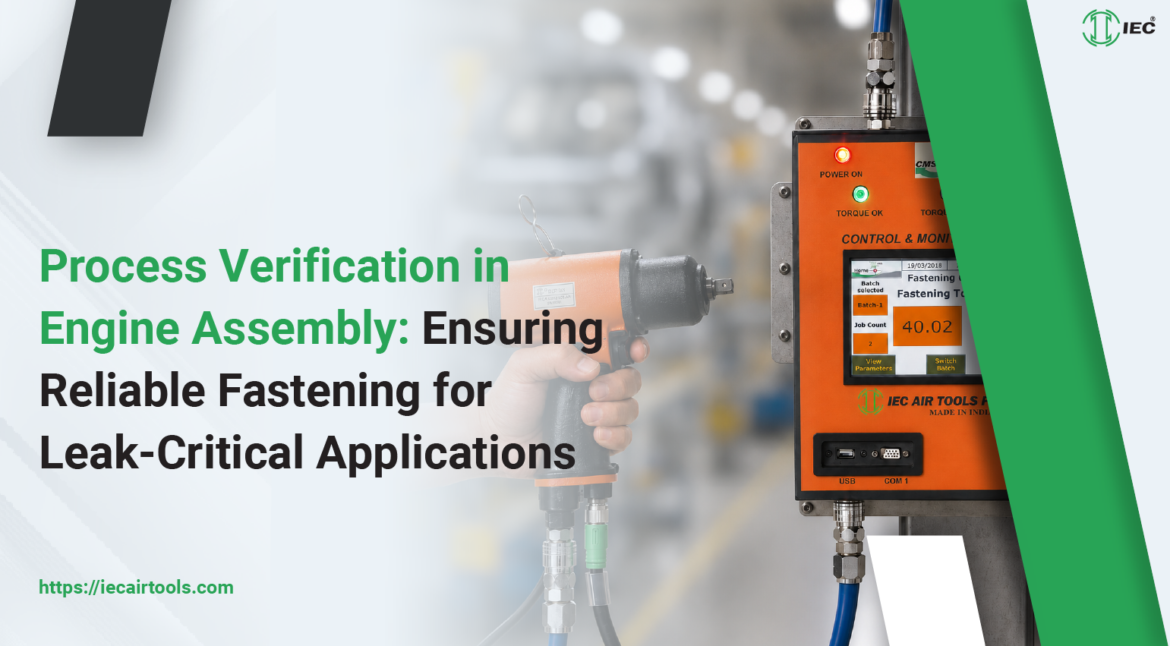
To address these requirements, IEC Air Tools supplied an Accura Oil Pulse Wrench integrated with its Cycle Monitoring System (CMS).
The Oil Pulse Wrench delivered controlled torque for the application, while the CMS provided process monitoring of every fastening cycle with immediate OK/NOK validation against the defined process parameters. This enabled the customer to strengthen manufacturing process control by identifying fastening errors during production rather than after assembly.
For this critical engine assembly application, the integrated solution supported assembly quality by combining controlled fastening with process verification, helping manufacturers build greater confidence in leak-critical fastening operations before the product moved to the next production stage.
Built for Critical Fastening Applications
The solution brings together accurate torque application, immediate cycle validation, and process monitoring in a single fastening workflow. This can help manufacturers strengthen manufacturing quality assurance without adding additional inspection steps.
Product Highlight of IEC’s Integrated Solution |
|
| Feature | Production Benefit |
| Accura Oil Pulse Wrench | Controlled torque application |
| Cycle Monitoring System (CMS) | Cycle monitoring with OK/NOK validation |
| Integrated Solution | Supports process verification for critical assembly |
Process Verification Is Changing How Critical Joints Are Managed
The engine oil cooler application demonstrates a broader shift in manufacturing. For critical assemblies, achieving the specified torque is no longer the only objective. Manufacturers now need fastening systems that help verify the process as production happens.
By combining controlled fastening with process monitoring, manufacturers can strengthen manufacturing quality assurance while reducing reliance on downstream inspection for critical assembly operations.