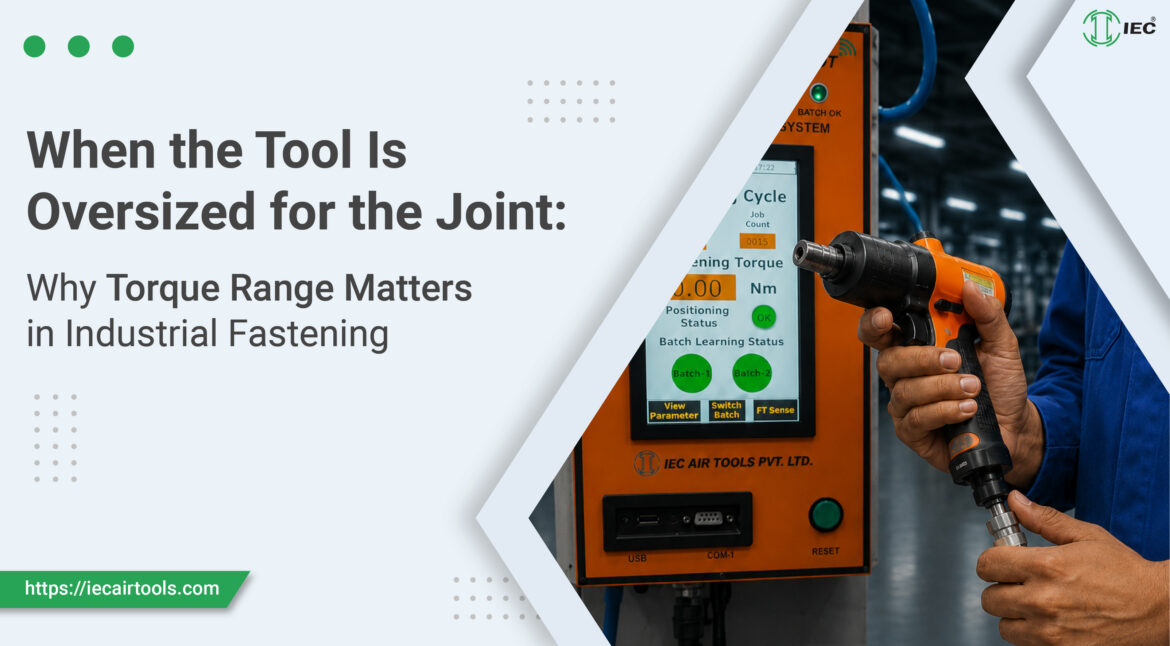
Selecting an industrial fastening tool is not simply about whether it can achieve the required torque. The tool also needs to be appropriate for the fastening conditions in which that torque must be delivered.
A tool with substantially greater torque capability may appear suitable because the required value falls below its maximum output. But maximum capability alone does not determine whether a tool is well matched to an application. Joint conditions, the required torque range, tool configuration, and production requirements all play a role in selecting the right fastening solution.
This distinction becomes important on high-volume assembly lines, where the same operation may be repeated hundreds or thousands of times. A mismatch that appears small at an individual workstation can affect process consistency, assembly quality, and production efficiency when repeated across an entire manufacturing cycle.
Why the Required Torque Should Drive Tool Selection
Every bolted joint is designed around specific fastening requirements. The objective is not to apply as much torque as the tool can produce, but to achieve the required fastening condition consistently.
This is why the usable torque range of a fastening tool matters. IEC’s Accura Oil Pulse Wrench range, for example, spans multiple models rather than using one tool across every application.
Published torque adjustment ranges extend from 8–13 Nm on the IAP-3D and IAP-3SD to 300–550 Nm on the IAP-24, allowing model selection to be aligned more closely with the application’s requirements.
IEC also identifies joint-condition assessment and suitable model selection as important considerations when choosing pulse tools. For manufacturers, this creates several practical considerations.
Tool Capability Is Not the Same as Application Suitability
A higher-capacity tool may be capable of producing a lower fastening requirement, but that alone does not make it the appropriate choice for the joint.
Joint Conditions Influence Tool Selection
Fastening behaviour differs according to the characteristics of the joint, making application assessment an important part of tool selection.
Repeatability Matters at Production Scale
On a manufacturing line, the objective is not one successful tightening cycle. The same fastening result needs to be supported across repeated operations, operators, and shifts.
Matching the tool to the application therefore becomes part of broader manufacturing process control, rather than simply an equipment-selection decision.
Case Insight: An 8–10 Nm Application Using a Tool with Nearly 100 Nm Capability
During a fastening process audit at a leading manufacturing facility, the IEC Air Tools team identified a significant difference between the joint requirement and the fastening tool being used.
The application required only 8–10 Nm of torque, while the existing tool had a torque capability approaching 100 Nm.
The fastening operation was being completed, but the audit raised a more important question: was the existing tool appropriately matched to what the joint actually required?
This distinction can be easy to overlook in production. A completed fastening cycle may appear satisfactory to the operator, while the suitability of the tool, torque setting, and overall process receives less attention. For the customer, IEC‘s assessment created an opportunity to reconsider the fastening process around the actual application requirement rather than the maximum capability of the existing equipment.
IEC Solution: Matching the Fastening System to the Application
IEC recommended an Accura Oil Pulse Tool suited to the required fastening range, together with a Cycle Monitoring System (CMS) to strengthen process monitoring and traceability.
IEC Accura Oil Pulse Wrenches use an air motor and oil pulse unit and are designed for controlled fastening across different torque ranges. The product range also allows torque adjustment within the specified range of each model, enabling manufacturers to select a tool according to the fastening application rather than relying on unnecessary torque capacity.
The CMS added another layer of manufacturing process control. IEC‘s system can monitor completed fastening cycles, provide real-time cycle information, support configurable cycle and batch counts, and provide visual OK/NOK feedback depending on the system configuration. IEC also offers CMS configurations for both compatible shut-off pulse tools and modified non-shut-off pulse tools.
Together, the solution addressed both sides of the customer’s requirement: a fastening tool better aligned with the joint and a monitoring system that provided greater visibility over the assembly process.
Product Highlight: Selecting the Appropriate Torque Range |
|
| Feature | Production Benefit |
| Application-specific torque ranges across the Accura Oil Pulse series | Helps manufacturers select a fastening tool suited to the joint requirement, supporting controlled and consistent fastening across repeated production cycles. |
IEC specifically recommends evaluating joint conditions and selecting the model most suitable for the application.
A Fastening Audit Looks Beyond Whether the Bolt Is Tight
A completed fastening cycle does not always mean the fastening process is optimised. Evaluating the joint requirement, tool selection, and process conditions together can reveal mismatches that routine production may not make obvious.
IEC Air Tools helps manufacturers identify these gaps and develop fastening solutions aligned with the actual requirements of the application.