Modern manufacturing is no longer built around a single assembly process. Production lines often handle multiple products, different fastening requirements, and changing production schedules within the same shift.
This flexibility improves manufacturing capability but also makes the fastening process more difficult to manage. Different jobs require different torque values, workflows, and operator actions, making it harder to maintain process consistency across the shop floor.
For manufacturers, the challenge extends beyond applying the correct torque. Every fastening operation must also follow the correct production process. This is why manufacturing process control has become an important part of managing complex assembly environments.
The Operational Challenges of Multi-Job Assembly
Managing a single fastening operation is relatively straightforward. Every operator follows the same workflow, applies the same torque requirement, and repeats the same process throughout production. Multi-job assembly operates differently.
1. Workload Balance Changes with Every Product
Multi-job assembly lines experience changing workloads as different product variants move through production. This can create temporary bottlenecks even when the line itself hasn’t changed.
2. The Fastening Process Begins Before the Tool Is Triggered
In multi-job assembly, selecting the correct fastening program and workflow is part of the fastening operation itself. A perfectly tightened bolt can still become a process error if the wrong job or sequence is selected.
3. Operator Decisions Increase Alongside Product Variety
Adding more product variants increases the number of decisions operators make throughout the shift. As decision points grow, maintaining a consistent process becomes just as important as achieving the correct torque.
4. Traceability Must Capture Context, Not Just Data
Recording a fastening cycle alone is rarely sufficient. Manufacturers also need to know which product, job, operator, and fastening program the data belongs to so every record can be linked back to the correct assembly process.
5. Production Flexibility Requires Greater Process Visibility
The advantage of a multi-job assembly line is its ability to adapt to changing production requirements. That same flexibility also makes it more difficult to monitor multiple workflows simultaneously, making real-time process visibility valuable.
6. Process Errors Can Occur Without Fastening Errors
A fastening operation may meet its specified torque while still failing the production process—for example, if the wrong tightening sequence or program is used. In complex assembly environments, process control helps identify these issues before they move downstream.
Case Insight: Managing Eight Fastening Jobs Through a Single Monitoring System
One manufacturer approached IEC Air Tools with a production challenge that reflected many of the operational realities found in multi-job assembly environments.
The facility managed eight different fastening and assembly jobs, each with its own process requirements. Rather than monitoring individual operations independently, the customer needed a way to manage all fastening activities through a single, coordinated system.
The objective was to improve visibility across multiple assembly jobs while maintaining the correct workflow for each operation. At the same time, the customer wanted better traceability and a more structured approach to monitoring the fastening process without adding to the complexity of day-to-day production.
IEC Solution
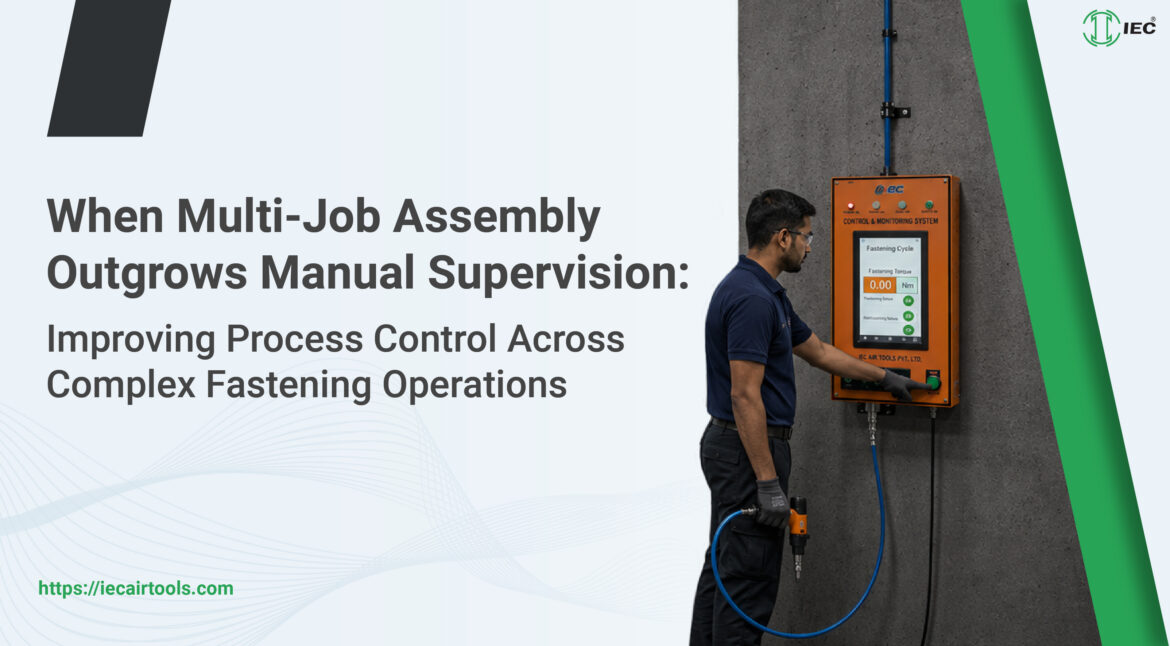
IEC Air Tools implemented its Cycle Monitoring System (CMS) to provide a centralised monitoring solution for all eight assembly jobs.
The system enabled operators to work within guided production workflows while allowing fastening activities to be monitored from a single platform. Dynamic job selection helped align the correct fastening process with changing production requirements, while complete traceability provided visibility into every fastening cycle across the assembly line.
By bringing multiple assembly jobs under one monitoring system, the customer gained greater control over the fastening process while supporting consistent execution across a more complex production environment.
Dynamic Job Selection for Multi-Job Assembly
As production requirements change throughout the shift, operators may need to switch between different assembly jobs without interrupting workflow. Dynamic Job Selection helps ensure the correct fastening process is assigned to the appropriate job, supporting smoother production transitions and reducing the risk of process deviations across multi-job assembly lines.
Product Highlight: Cycle Monitoring System – CMS (NS) |
|
Feature |
Production Benefit |
| Dynamic Job Selection | Automatically aligns the correct fastening workflow with changing production requirements, helping maintain process consistency across multiple assembly jobs. |
Preparing Assembly Lines for Greater Production Flexibility
Manufacturing complexity will continue to evolve as product portfolios expand and production becomes more responsive to market demand. The challenge is not to eliminate that complexity, but to manage it without compromising quality or production efficiency.
By strengthening process control at the fastening stage, manufacturers can create assembly operations that remain organised, repeatable, and scalable even as production requirements continue to change.
IEC Air Tools continues to help manufacturers build fastening processes that remain consistent as production evolves.