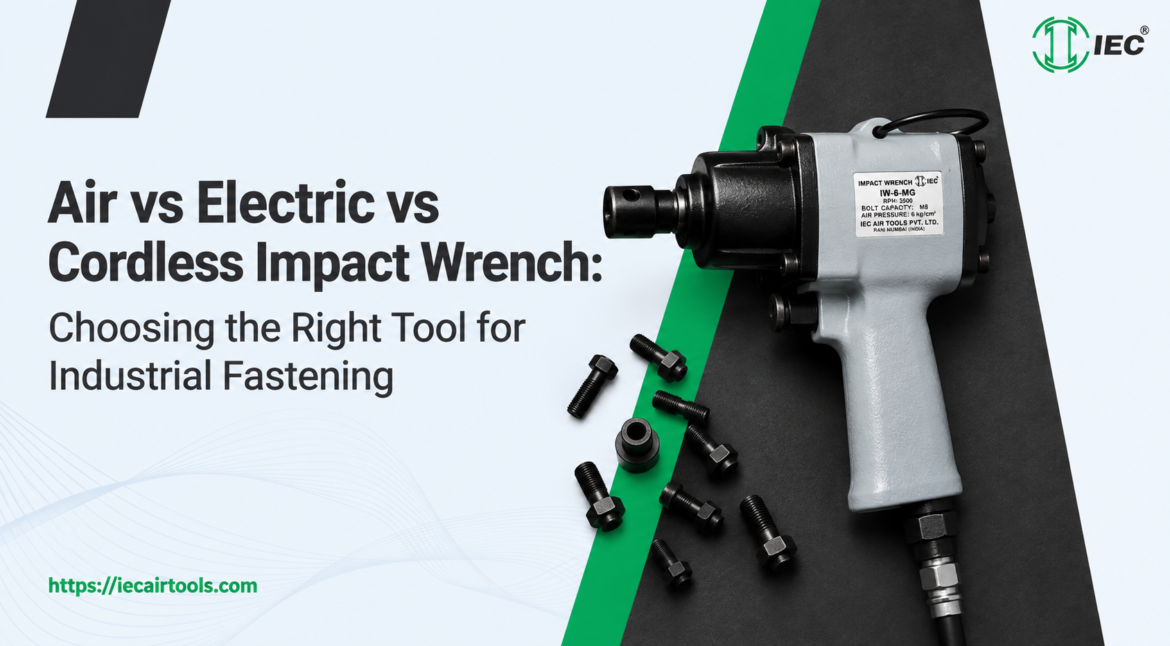
Choosing the right impact wrench for industrial use is not simply a question of maximum torque. Production environments place different demands on fastening tools, including cycle time, operator fatigue, mobility, maintenance, infrastructure, and the type of work being performed. This is why the choice between an air impact wrench, electric impact wrench, and cordless impact wrench depends heavily on the application.
For fixed production environments, pneumatic tools continue to be widely used because they combine high torque output, fast rundown, durability, and a favourable power-to-weight ratio. Electric and cordless tools, meanwhile, can offer advantages where electrical access, mobility, or installation flexibility are more important.
Understanding these differences helps manufacturers select an industrial impact wrench based on actual production requirements rather than choosing technology based on torque figures alone.
Air Impact Wrench: Where Pneumatic Power Makes Sense
An air impact wrench, also known as a pneumatic impact wrench, uses compressed air to generate the impact mechanism that delivers torque. These tools are particularly suited to demanding industrial applications where fastening speed, durability, and high torque output are important.
One of the main advantages of pneumatic impact technology is its power-to-weight ratio. Compressed air allows the tool to deliver high peak torque without requiring a heavy electrical motor and battery assembly. For operators performing repetitive fastening on large fasteners, this can support faster rundown and reduce the physical burden associated with prolonged tool use. Air impact wrenches are commonly suited to applications such as:
- Frame and chassis pre-assembly
- Structural sub-assemblies
- Heavy brackets and mounts
- Fabrication and fixture fastening
- Maintenance and rework operations
They also remain relevant in demanding production environments where tools are expected to operate for long periods. Pneumatic systems are generally well established on industrial shop floors, making compressed-air infrastructure a natural part of many manufacturing operations.
IEC Air Tools’ Lightweight Impact Wrenches are positioned for this type of industrial work, combining lightweight construction and ergonomic considerations with the high torque output expected from pneumatic impact technology. Their role is particularly relevant where operators need to perform high-torque fastening efficiently over demanding production cycles.
For manufacturers already operating pneumatic infrastructure, an air impact wrench can therefore provide a practical combination of power, durability, and operator usability without adding the battery management requirements associated with cordless equipment.
Electric Impact Wrench: When Electrical Power Fits the Application
Electric impact wrenches use an electric motor rather than compressed air to drive the impact mechanism. Their suitability depends on the production environment and the level of mobility and electrical infrastructure available.
One advantage of an electric impact wrench is that it does not require a compressed-air connection at the point of use. This can be useful in facilities where pneumatic infrastructure is limited or where electrical tools fit more naturally into the production setup.
Electric tools can also be appropriate for applications where the work environment is more controlled and fastening requirements do not justify maintaining a dedicated air supply.
However, industrial tool selection needs to consider more than the absence of an air hose. Motor heat, tool weight, power supply arrangements, maintenance requirements, and the expected duty cycle all influence whether an electric solution is appropriate for continuous production use.
For high-volume manufacturing, the key question is therefore not whether electric technology is newer, but whether its operating characteristics match the production process.
Cordless Impact Wrench: Where Mobility Matters
A cordless impact wrench removes both the air hose and the need for a direct electrical connection during operation. This makes cordless tools particularly useful when operators need to move between work areas or when fastening takes place away from fixed production stations.
Typical applications can include:
- Maintenance work
- Field service
- Mobile assembly
- Equipment installation
- Repair and rework operations
- Applications where access to compressed air is inconvenient
The primary benefit is flexibility. Operators can take the tool directly to the workpiece without managing an air hose or electrical cable.
However, cordless operation introduces another consideration: battery management. Runtime depends on the battery and workload, and production teams need to consider charging, spare batteries, battery replacement, and the availability of tools during extended operations.
For intermittent or mobile fastening, these considerations may be acceptable. For continuous, fixed-station industrial production, however, the priorities can be different. In such environments, the availability of established compressed-air infrastructure can make an air impact wrench a more practical choice.
Air vs Electric vs Cordless Impact Wrench: Key Differences
The three technologies can all perform impact fastening, but they are suited to different operating conditions.
| Factor | Air Impact Wrench | Electric Impact Wrench | Cordless Impact Wrench |
| Power source | Compressed air | Electrical supply | Battery |
| Mobility | Limited by air hose | Limited by electrical connection | High |
| Fixed production use | Strong fit | Application dependent | Application dependent |
| Mobile work | Less convenient | Moderate | Strong fit |
| Long production use | Well suited where air infrastructure exists | Depends on tool and duty cycle | Depends on battery/runtime |
| Infrastructure | Requires compressed air | Requires electrical supply | Requires charging/battery management |
| Operator flexibility | Good within station | Good within powered area | Very high |
| Typical strength | High-torque, demanding production work | Electrically powered applications | Mobility and flexibility |
The important point is that there is no universal winner. Tool selection should follow the operating environment, fastening requirements, and production model.
Why Air Impact Wrenches Remain Relevant in Industrial Assembly
The increasing availability of electric and cordless tools has not removed the need for pneumatic impact technology. In many industrial environments, the basic requirements remain unchanged: the tool needs to deliver the required torque quickly, withstand demanding operating conditions, and remain manageable for the operator.
This is particularly important in heavy assembly. Impact wrenches are often used for structural or preparatory fastening where the priority is efficient rundown and high torque rather than detailed cycle-level torque measurement.
Pneumatic impact tools can also form part of a broader fastening strategy. A production line does not necessarily need to use the same technology for every joint. An impact wrench can handle structural or high-torque work, while pulse or controlled fastening tools can be reserved for joints where greater process control is required.
This application-based approach helps manufacturers avoid over-engineering lower-risk fastening operations while still applying greater control where joint criticality demands it.
Which Impact Wrench Is Best for Industrial Use?
The right industrial impact wrench depends on where and how the tool will be used.
An air impact wrench is often the practical choice for fixed industrial environments where compressed-air infrastructure is available, and the priorities are high torque, fast rundown, durability, and repeated use.
An electric impact wrench may make more sense where electrical power is readily available and compressed-air infrastructure is not part of the production setup.
A cordless impact wrench is better suited to applications where mobility is the priority. Maintenance, field work, installation, and mobile assembly can benefit from removing the constraints of an air hose or fixed power connection.
The decision should therefore begin with the application rather than the tool category. For manufacturers evaluating pneumatic impact technology for demanding industrial applications, IEC Air Tools’ Lightweight Impact Wrenches provide a focused solution built around the requirements of high-torque fastening, operator usability, and production performance.
Frequently Asked Questions
1. Are air impact wrenches better than cordless impact wrenches for industrial use?
It depends on the application. Air impact wrenches are particularly suited to fixed industrial environments with compressed-air infrastructure, high fastening volumes, and demanding torque requirements. Cordless tools offer greater mobility and can be more practical for maintenance, installation, and mobile work.
2. What is the difference between a pneumatic and cordless impact wrench?
A pneumatic or air impact wrench operates using compressed air, while a cordless impact wrench uses a battery-powered electric motor. Pneumatic tools are well suited to established production environments, while cordless tools provide greater freedom of movement.
3. Which impact wrench is best for heavy assembly?
For heavy assembly applications involving high-torque fastening, structural components, and repeated production use, pneumatic impact wrenches can be a strong fit. The choice should still be based on the specific fastening requirements and operating conditions.
4. Are cordless impact wrenches suitable for production lines?
They can be suitable for applications where mobility is important, or fastening is intermittent. For continuous fixed-station production, manufacturers should also consider battery management, runtime, charging requirements, and the availability of pneumatic infrastructure.
5. What should I consider when choosing an industrial impact wrench?
Consider torque requirements, fastening frequency, duty cycle, operator ergonomics, mobility, available air or electrical infrastructure, maintenance requirements, and the type of assembly work. The correct tool is the one that matches the production conditions rather than simply offering the highest nominal torque.