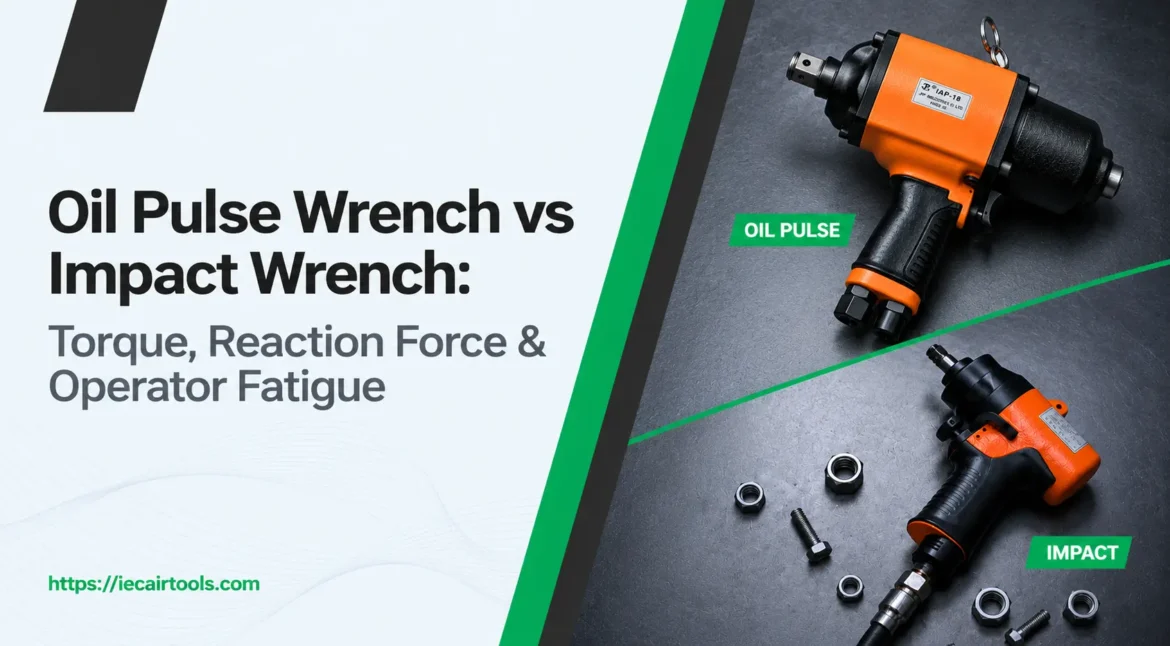
Choosing between an oil pulse tool and impact wrench depends heavily on how the fastening operation behaves on the production floor. Both are pneumatic tools capable of delivering high torque, but they generate that torque differently.
An oil pulse wrench uses a hydraulic pulse mechanism, while an impact wrench uses a mechanical hammer mechanism. That difference affects torque delivery, reaction force, noise, vibration, operator handling and the type of fastening work each tool suits. These differences are at the heart of the Oil Pulse Wrench vs Impact Wrench comparison.
IEC’s fastening range covers both technologies, along with transducerised and shut-off pulse options for applications with greater torque-control requirements.
Six IEC Tool Options at a Glance
| Tool type | Torque mechanism | Main characteristic | Suitable for |
| Accura Oil Pulse Wrench | Hydraulic pulse | Low reaction, adjustable torque | Repetitive assembly fastening |
| Accura Oil Pulse Shut-Off Wrench | Hydraulic pulse + automatic shut-off | Stops at preset torque | Controlled repetitive fastening |
| Accura Pulse N Series | Hydraulic pulse | Designed for limited air pressure | Heavy-duty applications with restricted air supply |
| Accura FT Transducerised Pulse Tool | Hydraulic pulse + transducer | Torque measurement and control | Precision fastening and process monitoring |
| Impact Wrench | Mechanical impact | Fast rundown and high torque | High-torque and rapid fastening |
| Lightweight Impact Wrenches | Mechanical impact | Reduced weight and high power-to-weight ratio | Repetitive high-force fastening |
IEC’s lightweight impact range includes both the N Series and + Series, with different configurations for operator handling and high-force applications.
The Torque Mechanism Changes the Way the Tool Feels
An oil pulse tool builds torque through hydraulic pressure inside its pulse unit. The air motor drives the mechanism, and hydraulic pulses transfer torque to the output spindle.
An impact wrench works through a dual-hammer mechanism. The hammer repeatedly strikes the anvil to generate torque, allowing the tool to deliver high torque with rapid rundown. IEC uses a dual-hammer mechanism in its impact wrench range for fast rundown in mass-production applications.
The difference becomes particularly noticeable when the operator holds the tool throughout a fastening cycle, which is an important consideration in an Oil Pulse Wrench vs Impact Wrench comparison. Hydraulic pulse technology avoids the metal-to-metal impacting associated with conventional impact mechanisms. IEC’s Accura Oil Pulse Wrenches use this hydraulic mechanism to reduce noise and vibration and eliminate reaction during operation.
Reaction Force Is a Key Selection Factor
Torque capacity tells you what the tool can deliver. Reaction force tells you more about what the operator experiences while it does that work.
The hydraulic pulse mechanism breaks torque delivery into short pulses, reducing the reaction transferred back through the tool. This is one reason pulse tools are widely used for manual assembly where operators repeat the same fastening operation throughout a shift.
An impact wrench also has a relatively favourable reaction characteristic compared with a continuously rotating high-torque tool because much of the reaction is associated with accelerating the hammer mechanism. However, its mechanical impact action produces a different noise and vibration profile from a hydraulic pulse tool.
A comparative technical discussion published by ASSEMBLY identifies low torque reaction as a major advantage of pulse tools and notes their combination of speed and torque for manual assembly.
Operator Fatigue Depends on More Than Tool Weight
An operator may handle a fastening tool hundreds of times during a shift. Weight matters, but so do reaction, vibration, grip, balance and the amount of force required to position the tool.
IEC’s Accura Oil Pulse range combines hydraulic pulse technology with ergonomic design, rubber grips and a high power-to-weight ratio. Its N Series pulse tools are also designed around lightweight construction and operator comfort.
Impact wrenches can also be designed around operator ergonomics. IEC’s lightweight impact ranges focus on reducing tool weight while maintaining torque output. The + Series, for example, includes models from 2.6 kg to 13.5 kg and is designed around power-to-weight ratio, balanced weight distribution and prolonged use.
For repetitive fastening, the practical question is therefore how much physical effort the complete fastening cycle demands.
Torque Control Separates the Tool Categories
The choice becomes clearer when the fastening process requires more than torque delivery.
A standard oil pulse tool provides adjustable torque within its specified range. The Accura Oil Pulse range covers multiple torque levels and is designed for both hard and soft joints.
The ST+ shut-off range adds automatic shut-off when the preset torque is reached. IEC specifies models such as the IAP-4ST+ at 9–15 Nm, IAP-6ST+ at 20–35 Nm and IAP-10ST+ at 85–110 Nm.
The Accura FT range moves further into torque control and measurement, making it relevant where the fastening process requires measured torque data.
An impact wrench occupies a different position. IEC describes its impact tools around high torque, rapid rundown and mass-production fastening, without positioning them as torque-measuring tools.
Joint and Air Supply Still Matter
The same tool can behave differently depending on the joint and pneumatic conditions. A hard joint reaches resistance quickly, while a soft joint allows more fastener rotation before the target torque is reached. IEC specifically recommends assessing joint conditions when selecting an oil pulse tool.
Air supply also affects performance. IEC specifies 6 kg/cm² operating pressure for its standard impact wrench range, while the Accura N Series pulse tools are designed for applications where available air pressure is limited. That makes joint behaviour and available air pressure useful filters before comparing individual models.
Which Tool Fits the Application?
| Requirement | Oil Pulse | Shut-Off Pulse | FT Pulse | Impact Wrench |
| High torque | ✓ | ✓ | ✓ | ✓ |
| Low reaction | ✓ | ✓ | ✓ | — |
| Repetitive manual assembly | ✓ | ✓ | ✓ | ✓ |
| Automatic torque shut-off | — | ✓ | ✓ | — |
| Torque measurement | — | — | ✓ | — |
| Fast rundown | ✓ | ✓ | ✓ | ✓ |
| Limited air pressure option | N Series | — | — | — |
For repetitive assembly where reaction force, operator handling and torque consistency are important, the Oil Pulse Wrench vs Impact Wrench choice comes down to how those factors align with the application.
For rapid rundown and high-torque fastening where direct torque measurement is not the primary requirement, an impact wrench remains a practical option.
The decision ultimately comes down to the joint, required torque, cycle, air supply and the amount of operator interaction built into the fastening process.
FAQs
1. Is an oil pulse wrench better than an impact wrench?
They are designed around different torque-generation mechanisms. An oil pulse wrench prioritises hydraulic torque delivery with low reaction and reduced vibration characteristics, while an impact wrench uses mechanical impact for rapid rundown and high-torque fastening.
2. Which has less operator fatigue, an oil pulse wrench or impact wrench?
Operator fatigue depends on tool weight, balance, reaction, vibration, fastening frequency and working position. Oil pulse tools are designed with low reaction and reduced vibration characteristics, while IEC’s lightweight impact ranges address fatigue through reduced weight and high power-to-weight ratios.
3. Can an oil pulse tool replace an impact wrench?
For some repetitive assembly applications, yes. The correct choice depends on the torque requirement, joint behaviour, required rundown speed, operator handling and whether the process needs shut-off or torque measurement.
4. What is the difference between an oil pulse tool and a shut-off pulse tool?
A shut-off pulse tool adds an automatic stopping mechanism to the hydraulic pulse system. IEC’s ST+ tools shut off when the preset torque is reached.
5. When should I choose a transducerised pulse tool?
Choose a transducerised pulse tool when the fastening process requires torque measurement, control and process data rather than adjustable torque alone. IEC’s Accura FT range is designed specifically around this requirement.