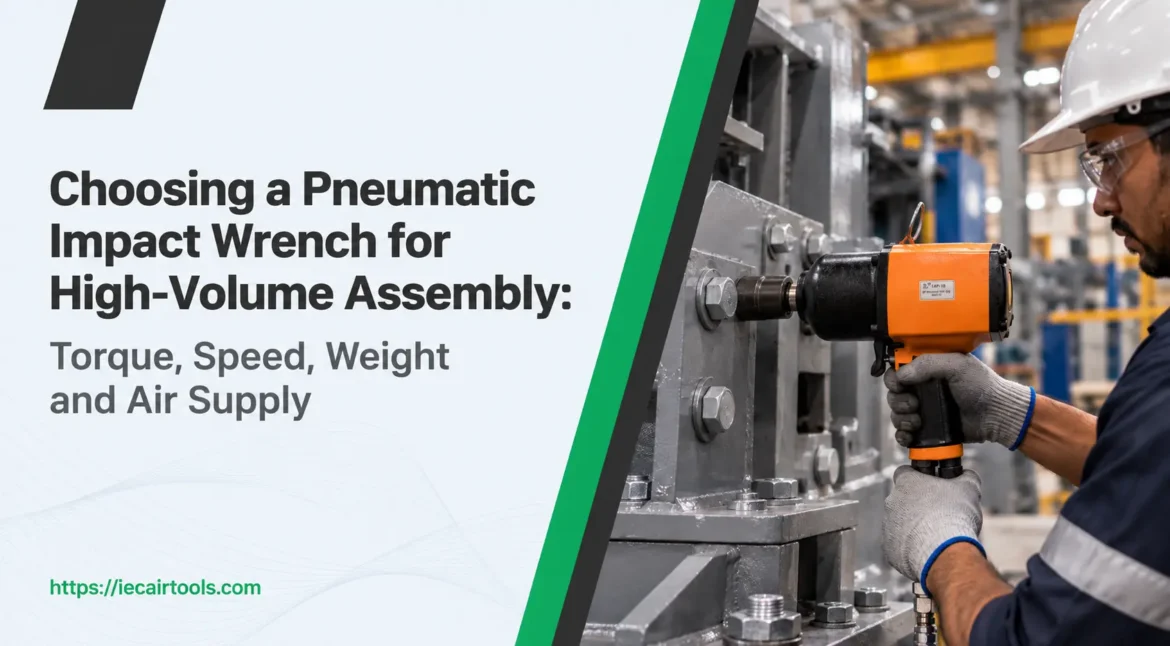
In high-volume assembly, the right pneumatic impact wrench depends on the fastening application, production cycle, operator requirements and available air supply. Torque capacity is one part of that decision, alongside speed, tool weight, configuration and expected usage.
For applications where fast rundown, high torque output and durable operation are priorities, a pneumatic impact wrench can be an effective choice. IEC’s impact wrench range is designed for rapid rundown in mass-production assembly and includes configurations intended for different fastening requirements. Choosing the right model therefore starts with understanding what the fastening operation actually demands.
Torque, Fastener Size and Joint Requirements
The first step in selecting an impact wrench for assembly is understanding what the joint requires.
| Application factor | Why it matters |
| Required torque | Establishes the useful operating range |
| Fastener size | Influences drive size and tool capacity |
| Joint characteristics | Affects how the tool delivers its output |
| Production volume | Determines suitability for repetitive use |
| Access | May require a different tool configuration or accessory |
A tool with substantially more capacity than the application needs can add unnecessary weight and may not offer a practical advantage. Conversely, selecting a tool too close to the application’s upper requirement can leave little room for variation in real production conditions.
IEC’s pneumatic impact wrench range covers different torque and speed requirements, allowing selection according to the fastening application rather than treating every joint the same way.
Speed and the Actual Fastening Cycle
An air impact wrench can spend a significant part of the fastening operation running the fastener down before impact action becomes the dominant part of the cycle. Free speed therefore has a direct relationship with how quickly the tool can move through the rundown stage.
But maximum RPM should not be treated as a standalone measure of productivity, because prolonged impacting can contribute to heat and mechanism wear. This makes speed a production-cycle consideration, rather than simply a specification to compare between two tools.
| Specification | What it helps indicate |
| Free speed | Rundown potential |
| Torque capacity | Available fastening output |
| Impact mechanism | How the tool delivers torque |
| Weight | Handling requirements |
| Air consumption | Pneumatic system demand |
For a high-volume pneumatic impact wrench, the useful combination is enough torque for the joint with speed appropriate to the actual cycle.
Weight, Balance and Repetitive Handling
Power-to-weight ratio can be more useful than looking at weight alone. The objective is not simply to find the lightest tool, but to achieve the required fastening output without adding unnecessary mass to every cycle.
Tool balance and ergonomics matter as well. A well-balanced lightweight impact wrench can be easier to position and handle repeatedly, particularly when operators are performing the same fastening operation for long periods.
IEC’s + Series Light Weight Impact Wrenches are designed with ergonomic features and balanced weight distribution while maintaining high torque output.
Air Supply and Tool Performance
The performance of a pneumatic impact wrench depends on the quantity of compressed air available to the tool under its actual operating conditions.
IEC specifies an operating pressure of 6 kg/cm² for its impact wrench range and specifies hose requirements for its models. This makes the air system part of the selection process. A practical check should include:
| Operating pressure at the tool | Available airflow | Hose diameter and length |
| Coupler and fitting restrictions | Regulator setting | Simultaneous demand from other pneumatic tools |
A correctly selected industrial impact wrench can still underperform if the air supply cannot support it under actual production conditions.
Configuration for Different Applications
Not every fastening point is presented to the operator in the same way. Access, working position and socket arrangement can determine whether the standard configuration of a pneumatic impact wrench is suitable. This is where application-specific configuration becomes useful.
| Production requirement | Possible consideration |
| Recessed or difficult-to-reach joint | Extended anvil |
| Different drive arrangement | Drive anvil |
| Output adjustment | Air regulator |
| Specific socket requirement | Impact socket |
| Restricted working space | Appropriate tool configuration |
IEC offers accessories including extended anvils, drive anvils, air regulators and impact sockets for its impact wrench range. The point is to consider the complete fastening setup before deciding which impact wrench for assembly will work best at the station.
See IEC Light Weight Impact Wrench Options
Service Life on a Production Line
The purchase price tells you what the tool costs on day one. High-volume production makes the rest of its service life much more important. A pneumatic impact wrench used continuously needs an appropriate maintenance routine, accessible spare parts, and dependable technical support. If a tool is unavailable, the cost is no longer limited to the tool itself; it can affect the production station around it. Before selecting an industrial impact wrench, consider:
- Tool life: Can it withstand the expected production duty?
- Maintenance: Are routine servicing requirements practical for the production environment?
- Spare parts: Can replacement components be sourced without unnecessary delays?
- Service support: Is technical assistance available when the tool needs attention?
IEC offers after-sales service and spare-parts availability through its authorised dealer network. For high-volume assembly, these factors belong in the selection discussion from the beginning rather than after a tool is already installed.
Impact Wrenches and Controlled Fastening
There is also value in deciding where not to use an impact wrench. Not every joint has the same process requirement.
| Requirement | Pneumatic impact wrench | Controlled fastening technology |
| Fast rundown | Strong fit | Application dependent |
| High-volume fastening | Strong fit | Application dependent |
| High torque output | Strong fit | Application dependent |
| Direct torque measurement | Not available | Better suited |
| Cycle-level torque data | Not available | Better suited |
| Detailed process traceability | Not available | Better suited |
This distinction matters because a pneumatic impact wrench and a transducerised fastening tool serve different purposes.
Pneumatic Impact Wrench: A Practical Selection Checklist
A practical selection process can be reduced to ten questions:
- What torque does the joint require?
- What fastener and drive size are involved?
- What are the joint characteristics?
- How quickly does the production cycle need the fastener to run down?
- How frequently will the tool be used?
- Is the power-to-weight ratio appropriate for repetitive handling?
- Can the operator use the tool comfortably throughout the shift?
- Can the air system maintain the required pressure and airflow?
- Does the joint require a specific configuration or accessory?
- What maintenance and service support will be available?
Once these are established, comparing individual pneumatic impact wrench models becomes much more meaningful.
Choosing for the Application, Not the Specification Sheet
For high-volume assembly, the best pneumatic impact wrench is not necessarily the largest or fastest model available. The tool needs to fit within the broader fastening strategy of the production line. IEC Air Tools offers impact wrench options across different torque ranges, configurations, and lightweight designs, along with accessories for application-specific requirements.
FAQs
1. What should I consider when choosing a pneumatic impact wrench for high-volume assembly?
Consider the required torque, fastener size, rundown speed, production volume, power-to-weight ratio, air supply, operator handling, tool configuration, accessories, and service support.
2. How much torque should a pneumatic impact wrench have?
The required impact wrench torque should be based on the actual joint requirement and its operating conditions. Choosing a tool with substantially more capacity than necessary does not automatically make it a better production choice.
3. Does a higher RPM make a pneumatic impact wrench better for production?
Not necessarily. Free speed can reduce rundown time, but joint characteristics, torque requirements, and impact behaviour also influence the actual fastening cycle.
4. Why does power-to-weight ratio matter in an impact wrench?
Power-to-weight ratio shows how much fastening output is available relative to the mass the operator has to handle. It can be particularly relevant when an impact wrench for assembly is used repeatedly throughout a shift.
5. What air pressure does a pneumatic impact wrench need?
The required pressure depends on the tool. IEC specifies 6 kg/cm² operating air pressure for its impact wrench range. The air system must also provide sufficient airflow at the tool during operation.
6. When should I use an impact wrench instead of a controlled fastening tool?
A pneumatic impact wrench is well suited to high-speed rundown and high-torque applications where direct torque measurement is not required.