Quick Summary:
A tightening strategy defines how fasteners are tightened to achieve a reliable joint. It covers the fastening sequence, initial tightening to bring mating components into contact, and final torque to develop the required clamping force. The right approach depends on joint design, fastener specifications and production requirements, helping manufacturers maintain consistent fastening quality across assembly lines.Tightening Strategy for Assembly Lines: Sequence, Initial & Final Torque
Applying the specified torque is important, but the order and method of tightening also influence how a multi-bolt joint seats and how clamping load is distributed.
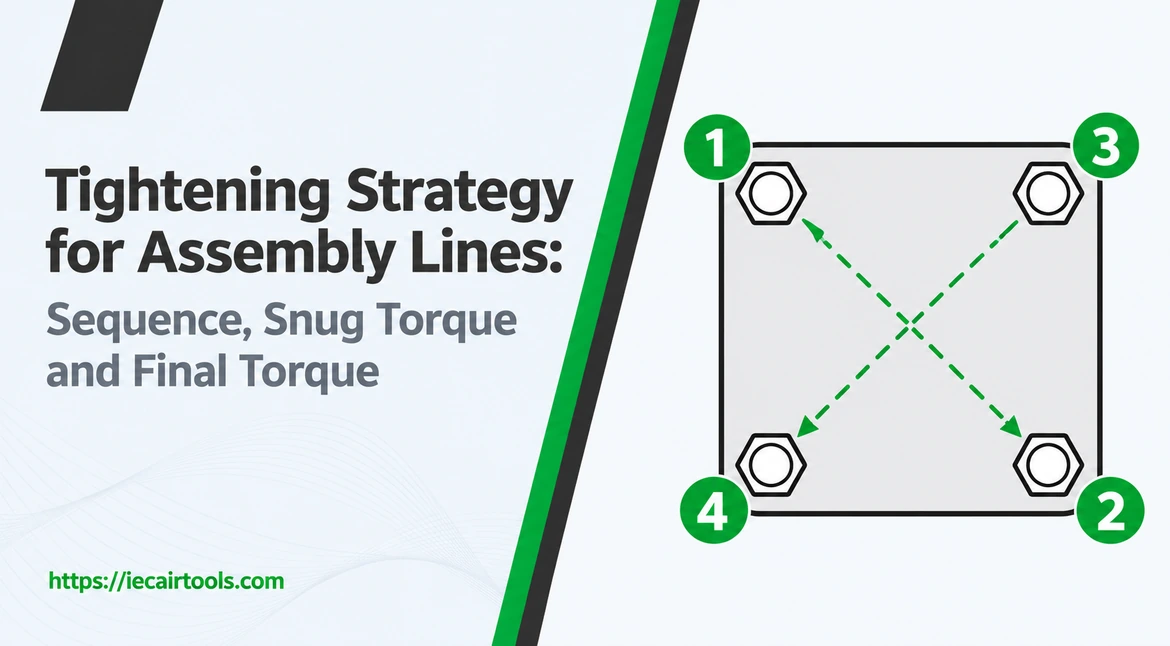
For example, fully securing one bolt while the others remain loose can pull a four-bolt cover unevenly against its mating surface.
A defined strategy sets out the fastening sequence and any tightening stages required by the joint.
What Is a Tightening Strategy?
A tightening strategy defines the order, stages and control criteria for installing fasteners to meet a joint’s requirements.
Three considerations are relevant:
- Fastening sequence: The order in which individual fasteners are tightened.
- Initial tightening: A preliminary tightening stage used to bring mating components into firm contact.
- Final torque: The specified torque target used to develop the required fastener preload.
These elements are related, but they are not separate mandatory stages in every application. The method depends on joint geometry, fastener specifications, materials and operating loads.
Tightening Sequence: Why the Order Matters
Tightening sequence is the predetermined order in which bolts or screws are tightened. Each tightened fastener develops preload and clamps the components together. In a multi-fastener joint, this can change contact conditions and influence neighbouring fasteners.
For a cover with four bolts, a diagonal or cross-pattern sequence may be specified. Rather than securing bolts consecutively around the perimeter, the operator alternates between opposing corners.
A typical four-bolt cross-pattern may be:
| Top-left bolt | Bottom-right bolt |
| Top-right bolt | Bottom-left bolt |
This can help the cover seat more evenly. The sequence must come from the joint design; a cross-pattern is not universal.
Common applications include multi-bolt flanges, engine and gearbox housings, sealing covers and components where uneven seating can affect fit or function.
What to consider: Fastener position, component stiffness, gasket requirements and fastening method influence the sequence. For more detail, read Why Fastening Sequence Matters in Multi-Bolt Assemblies.
Snug Torque: Establishing Joint Contact
Some applications use an initial tightening stage before final torque is applied.
Initial tightening brings mating components into firm contact and establishes the starting condition for the next tightening stage.
For two plates joined by several bolts, an initial tightening pass can bring the plates together progressively before final torque is applied.
This initial stage may:
- Bring mating surfaces into contact.
- Reduce looseness between assembled components.
- Establish a starting condition for a staged tightening procedure.
What to consider: Initial tightening is application-specific, not a universal torque value or fixed percentage of final torque. It depends on the fastener, joint design and assembly procedure. Initial joint contact does not mean the fastener has achieved its required final preload, and some applications do not use a separate initial tightening stage at all.
Final Torque: Developing the Required Preload
After seating, the fastener may be tightened to its specified final torque, the target used to develop the required preload.
As the bolt stretches elastically, it develops tensile load and creates clamping force between the components. This helps the joint resist separation under its intended operating conditions.
A machinery housing, for example, may have a specified torque for its cover fasteners. The tightening tool is selected and set up to apply that target in accordance with the assembly specification.
Final torque helps achieve the specified preload, provide the required clamping force and reduce the risk of insufficient or excessive torque.
What to consider: Torque does not directly measure clamping force. Friction in the threads and beneath the fastener head consumes part of the applied torque. Lubrication, surface finish and fastener condition therefore affect the preload achieved. Critical joints may require validated procedures or additional controls, such as torque-angle monitoring.
How the Stages Work Together
Where required, sequence, initial tightening and final torque form a coordinated procedure. For a four-bolt cover, a typical process may involve:
- Position the components: Locate the cover against the housing and start the fasteners correctly.
- Establish initial joint contact: Bring fasteners to the specified initial condition, following the defined sequence.
- Apply final torque: Tighten each fastener to its specified target using the prescribed order.
- Verify the result: Check fastening results against acceptance criteria, where the tool and control system provide the required monitoring.
Some joints require multiple passes; others use one stage. The method must be defined for each particular joint application.
Selecting Tightening Tools for the Application
The strategy defines the required process; fastening tools determine how it is carried out.
Select tools based on torque range, joint characteristics, speed, access and process-control needs. A torque-controlled shut-off screwdriver, for example, stops the drive when it reaches its configured target. Accuracy and monitoring functions depend on the model and control system.
Automatic screw feeding and tightening systems can support operator-guided, fixtured and other machine-assisted applications.
IEC Air Tools offers torque-controlled shut-off screwdrivers and Weber screw feeding and tightening systems for industrial assembly fastening requirements. The appropriate configuration depends on the joint, production volume and assembly process.
Maintaining Consistency Across Tightening Operations
A defined procedure can still produce variable results if tools, fasteners or assembly conditions change. Manufacturers should consider:
- Tool verification: Check torque tools at defined intervals using suitable equipment and procedures.
- Fastener consistency: Control fastener specifications and assembly conditions, including lubrication where specified.
- Process control: Use monitoring features supported by the tool and controller to identify results outside acceptance limits.
- Work instructions: Make the fastening order and torque requirements clear to operators and production teams.
These measures help align fastening operations with the joint specification and identify deviations.
Frequently Asked Questions
1. What is a tightening strategy in manufacturing?
A tightening strategy defines how fasteners are installed, including order, torque targets and any intermediate stages.
2. What is the difference between initial tightening and final torque?
Initial tightening establishes contact between mating components. Final torque is the specified target used to develop the required fastener preload. Not every application uses a separate initial tightening stage.
3. Why does fastening sequence matter?
The order of fastening can affect component seating and load distribution in a multi-fastener joint. A sequence suited to the joint helps achieve the intended assembly condition.
4. Does the correct torque guarantee the correct clamping force?
No. Friction, lubrication, surface finish and fastener variation influence the relationship between torque and preload. Torque is an indirect method of controlling preload, not a direct measurement of clamping force.
5. Which bolt tightening tools are used on assembly lines?
Common options include torque-controlled screwdrivers, shut-off screwdrivers, nutrunners and integrated fastening systems. Selection depends on the fastener, torque range, access and process requirements.
6. Can fastening operations be automated?
Yes. Automated stations can control tool movement and fastening operations. Depending on the equipment, they may also monitor torque or other tightening parameters and record results.