Quick Summary
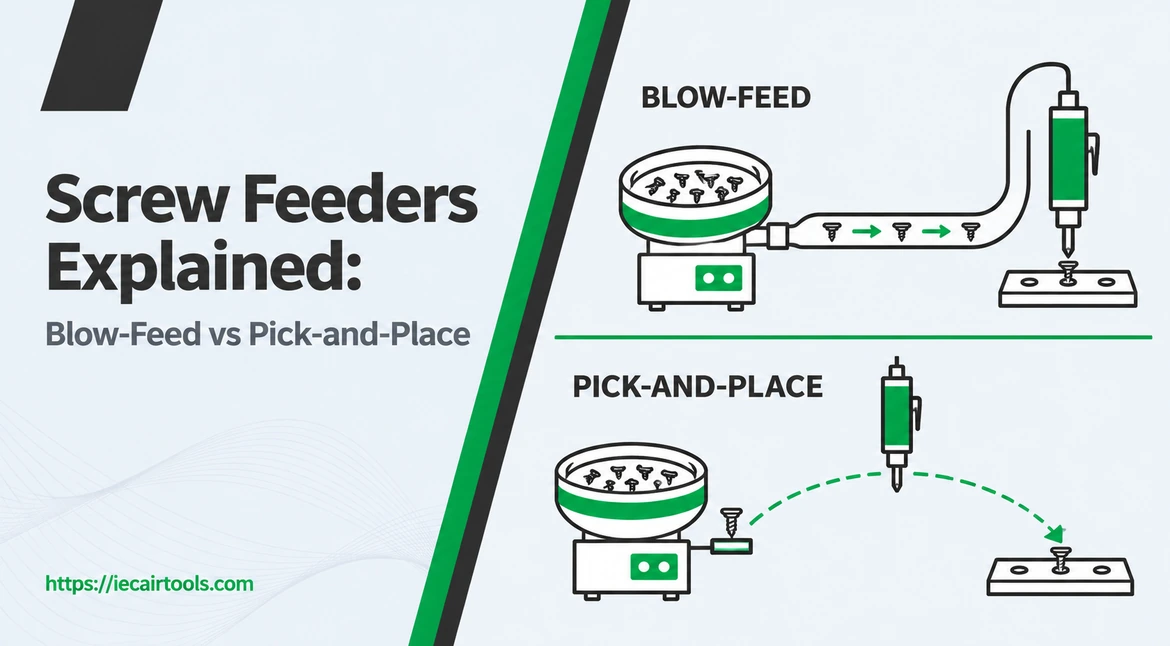
An automatic screw feeder sorts loose screws and delivers them one at a time to a screwdriver. Blow-feed uses compressed air to send screws through a hose, while pick-and-place feeds screws one at a time along an open track before a mechanism picks and places each screw at the screwing location. The right method depends on fastener geometry, access, and cycle-time requirements.
When an operator fastens small screws by hand, tightening is only part of the job. Each screw must first be picked up, oriented, placed on the screwdriver bit and brought to the joint. Repeating these steps across hundreds of fastening points adds handling time to the production cycle. Dropped screws and poorly aligned starts can create further delays.
An automatic screw feeder reduces this manual handling. It sorts loose screws, separates them one at a time, and delivers each screw to the screwdriver for fastening.
Blow-Feed vs Pick-and-Place
There are two common ways to deliver screws: blow-feed and pick-and-place. The difference lies in how the screw reaches the tool, and that choice affects which fasteners can be handled reliably and how quickly the station can operate.
This guide explains how both methods work, where each is suitable, and what manufacturers should consider before choosing a system. The screwdriver itself may be handheld or mounted on a fixture. That is a separate decision from the screw delivery method. See our guide to Handheld vs Fixtured Screwdrivers.
How an Automatic Screw Fitting Machine Works
An automatic screw fitting machine brings together four main components:
- Feeder: Stores loose screws, orients them and releases them one at a time through an escapement. A bowl feeder uses vibration to move screws along a track. A step feeder lifts screws in stages and can be suitable for coated or delicate parts.
- Delivery system: Transfers each screw to the screwdriver through a feed hose or from a fixed pickup point.
- Screwdriver: Drives the screw into the joint. It can be handheld or mounted on a fixture.
- Controller: Coordinates the operating sequence and, depending on the system, monitors the fastening result.
These components work together to supply screws and drive them as part of the assembly process.
Blow-Feed: Sending the Screw Through a Hose
In a blow-feed system, the feeder releases one screw at a time, and compressed air carries it through a hose to the screwdriver. The screw enters the tool’s mouthpiece, which holds it in position for driving. Depending on the system, screw travel speeds can reach around 10 metres per second.
The main advantage is that the screw comes to the tool. The operator or fixture does not need to travel to a separate pickup point for every fastener. The next screw can also be delivered while the current one is being driven.
This makes blow-feed suitable for repetitive, high-volume fastening when the screw can travel reliably through the hose.
How Blow-Feed Handles Screws and Where It Falls Short
The key limitation is fastener geometry. A screw must maintain the correct orientation as it moves through the hose. Short screws with relatively large heads, top-heavy screws and some nuts can tumble inside a round hose and reach the tool in the wrong position. Depending on the application, manufacturers can address this by:
- Reviewing the fastener design, if changes are still possible.
- Using a profile hose shaped to the fastener, which can prevent it from turning over but may require tighter fastener tolerances.
- Choosing pick-and-place when reliable hose delivery is not practical.
Pick-and-Place: Moving the Screw to the Joint
In a pick-and-place system, the feeder presents screws one at a time at a fixed pickup point. The screwdriver, or a robot carrying it, picks up each screw and moves it to the fastening position. Vacuum can hold the screw on the bit during transfer.
This method suits fasteners that cannot travel reliably through a hose, including some short screws and screws with unusual head shapes. Vacuum pickup can also help hold a screw in position when approaching a recessed joint.
The trade-off is additional movement. The tool must travel between the pickup point and the joint for each screw. Depending on the station layout and distance involved, this can increase cycle time compared with blow-feed. Pick-and-place is therefore worth considering when fastener handling or access makes blow-feed unsuitable, even if the delivery cycle is longer.
Blow-Feed vs Pick-and-Place at a Glance
| Consideration | Blow-Feed | Pick-and-Place |
| How the screw reaches the tool | Compressed air carries it through a hose | The tool picks it up from a presenting point |
| Suitable fasteners | Screws that maintain their orientation in a hose | Fasteners that are difficult to deliver through a hose |
| Movement during delivery | No separate trip to a pickup point | Tool travels between pickup point and joint |
| Cycle time | Generally shorter when hose delivery is reliable | Can be longer because of the additional movement |
| Main checks | Fastener geometry, hose routing and reliable delivery | Pickup access, tool travel and screw retention |
Neither method is automatically the better choice for every assembly. The fastener, joint and production layout determine which one is more suitable.
Choosing the Right Screw Feed Technology
Before selecting a screw feed technology, evaluate the actual fastening application rather than the delivery method in isolation.
1. Check the fastener
Screw length, head shape, thread and coating can affect feeding reliability. Test the system with the fasteners intended for production.
2. Check access to the joint
Blow-feed requires a suitable hose route to the tool. Pick-and-place requires enough space for the tool to pick up the screw and reach the joint.
3. Evaluate the complete cycle
Consider screw delivery, tool positioning, tightening and verification. Faster screw delivery alone may not reduce the overall cycle time if another step is the bottleneck.
4. Account for product variants
If the station handles different products or screw sizes, check whether each fastener can use the same feeding setup or requires a separate arrangement or changeover.
5. Separate screw delivery from tightening control
The feeder delivers the screw; the screwdriver and process controls determine how tightening is performed and verified. Depending on the application, these may include depth control and OK/NOK verification.
How IEC Supports Automatic Screw Feeding
IEC Air Tools provides screw feeding and tightening systems, including feeding systems, handheld screwdrivers with automatic feeding and fixtured screwdrivers.
The appropriate configuration depends on the application. Fastener geometry, joint access, station layout and cycle-time requirements all influence how screws should be delivered and tightened.
By considering feeding and tightening together, manufacturers can select a system that fits the production process rather than treating screw delivery as an isolated operation.
Glossary
- Screw feeder: A system that sorts, separates and delivers screws to a screwdriver.
- Escapement: A mechanism that releases screws one at a time.
- Bowl feeder: A vibrating bowl that moves screws along a track for orientation and feeding.
- Step feeder: A feeder that lifts screws in stages and can be suitable for sensitive or coated parts.
- Blow-feed: A method of delivering screws through a hose using compressed air.
- Profile hose: A hose shaped to help prevent a fastener from turning over during delivery.
- Mouthpiece: The front section of the screwdriver that receives and aligns the screw.
- Pick-and-place: A method in which a screw is picked up from a presenting point and carried to the joint.
- Vacuum pickup: Suction used to hold a screw on the bit during transfer.
Frequently Asked Questions
1. What is a screw feeder used for in assembly?
A screw feeder sorts loose screws and delivers them one at a time to a screwdriver, reducing the need for manual picking and positioning.
2. What is the difference between blow-feed and pick-and-place?
Blow-feed uses compressed air to send a screw through a hose to the tool. Pick-and-place collects a screw from a presenting point and carries it to the joint. Blow-feed is generally faster when the fastener can travel reliably through the hose, while pick-and-place suits fasteners that are difficult to feed this way.
3. What is an automatic screw fitting machine?
An automatic screw fitting machine combines a screw feeder, a delivery method, a screwdriver and a controller to supply and drive screws as part of one assembly process.
4. Is an auto screw machine the same as a screw feeder?
Not always. In assembly, the term may refer to a screw feeding and driving system. In machining, an auto screw machine can mean an automatic lathe used to produce turned parts.
5. Can every screw be blow-fed?
No. Some short screws, top-heavy fasteners and nuts may tumble or lose their orientation in a round feed hose. A profile hose or a pick-and-place system may be more suitable.
6. Does a screw feeder control tightening quality?
No. A screw feeder manages screw delivery. Tightening quality depends on the screwdriver, its settings and the applicable process controls, which may include torque, depth and OK/NOK verification.