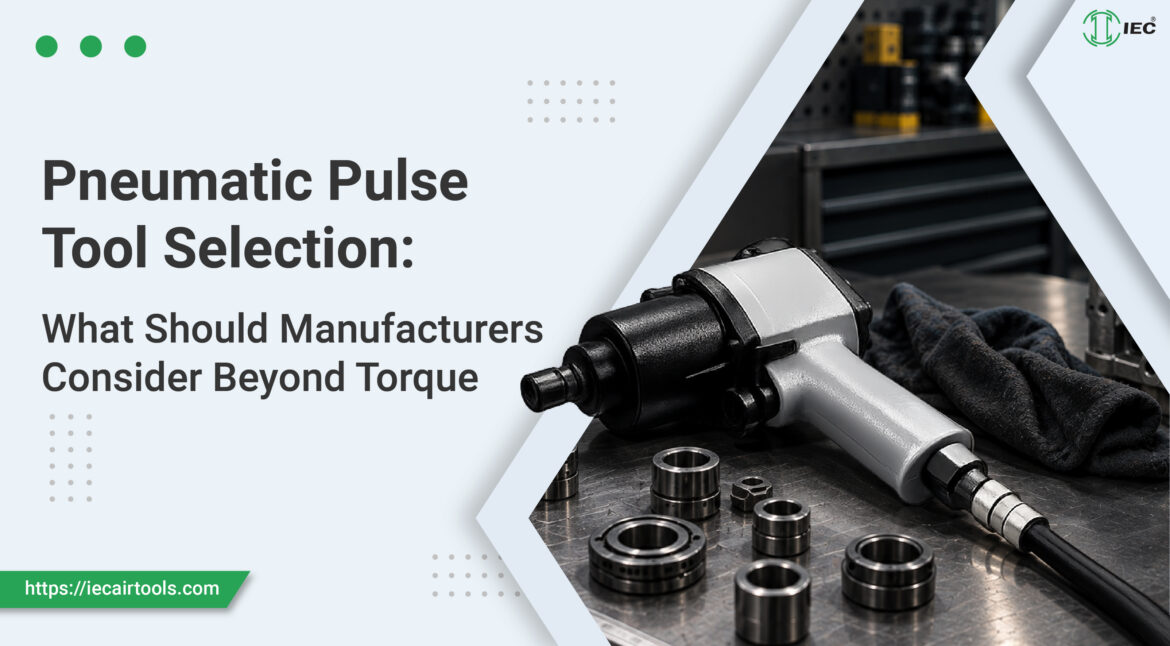
Selecting a pneumatic pulse tool involves more than matching the tool’s torque range to the fastening requirement. Torque remains an important starting point, but the joint, production volume, tool configuration, and operator requirements can all influence whether a particular tool is suitable for the application.
Two applications with similar torque requirements may therefore call for different tool considerations. A suitable pulse tool needs to deliver the required torque while also fitting the joint and production environment in which it will operate.
Torque Range Is Where Tool Selection Begins
The first step is to understand the fastening requirement of the joint. A tool should be selected according to its suitable torque adjustment range rather than simply choosing the highest-capacity model available. IEC’s Accura Oil Pulse Wrench range extends from 8–13 Nm on the IAP-3D/IAP-3SD to 300–550 Nm on the IAP-24, with multiple models between these ranges.
This allows model selection to be aligned more closely with the application’s requirements. But torque is only the starting point.
The Joint Influences More Than the Torque Requirement
Joint conditions can influence how a pulse tool performs during fastening. Hard and soft joints can have different tightening characteristics, which is why IEC recommends assessing the joint conditions when selecting a pulse tool.
The same torque requirement can therefore call for different tool considerations depending on how the joint behaves during tightening. For manufacturers, this makes joint assessment part of tool selection, rather than a separate consideration after the tool has already been chosen.
Production Conditions Change the Selection Criteria
A tool used for occasional maintenance does not face the same demands as one used repeatedly throughout a production shift. For high-volume assembly, manufacturers may also need to consider:
- Repetitive fastening cycles
- Operator handling
- Tool weight
- Reaction and vibration
- Noise levels
- Tightening speed
- Ease of adjustment
These factors do not replace the torque requirement. They determine how well the selected tool fits the production environment around that requirement.
Configuration Can Change the Right Tool Choice
Torque range alone does not determine whether a tool is suitable for a particular workstation. Tool configuration, overall length, square-drive size and weight can become relevant when the fastening operation involves specific positioning or repeated operator use.
The Accura Oil Pulse range includes different configurations and variants across its models, allowing selection to account for the application beyond torque alone. For example, the range includes standard, D, S and angular configurations across different models, depending on the fastening requirement.
Adjustability Adds Flexibility to the Same Tool
Manufacturing requirements can vary between products, fastening points or production variants. The ability to adjust torque without dismantling the tool can therefore be useful when a tool needs to be fine-tuned for an application.
Accura Oil Pulse Wrenches allow torque adjustment using an Allen key without dismantling the tool, providing a practical way to make application-level adjustments. This is particularly useful where the same production environment involves different fastening requirements within the tool’s suitable range.
The Tool Depends on the Air System Around It
Pneumatic tool performance also depends on the conditions in which the tool operates. IEC recommends using pulse tools at their rated working pressure and using appropriately sized hoses and couplers. The company also recommends maintaining a clean and dry air supply to support consistent operation and tool life. In other words, selecting the right tool is only part of the setup. The operating conditions need to support the tool as well.
Product Highlight: Accura Oil Pulse Wrenches
IEC’s Accura Oil Pulse Wrench range combines a double-chamber air motor with a hydraulic pulse unit to deliver torque across a broad range of fastening applications. The design also focuses on power-to-weight ratio, reduced vibration and noise, and operator comfort.
| Consideration | Accura Oil Pulse Wrench Capability |
| Torque requirement | 8–550 Nm across the range |
| Joint conditions | Designed for hard and soft joints |
| Torque adjustment | Adjustable without dismantling the tool |
| Operator considerations | Reduced vibration, low reaction and reduced noise |
| Tool selection | Multiple models and configurations |
From Tool Selection to Production Fit
A pneumatic pulse tool becomes part of the production system once it is selected around the way the assembly is actually built and produced. For manufacturers, that means the value of the tool is not only in the torque it delivers, but in how well it fits the application over the life of the production process.
IEC’s Accura Oil Pulse Wrenches are available across a broad range of torque requirements and configurations, allowing manufacturers to select a model suited to the specific fastening application.