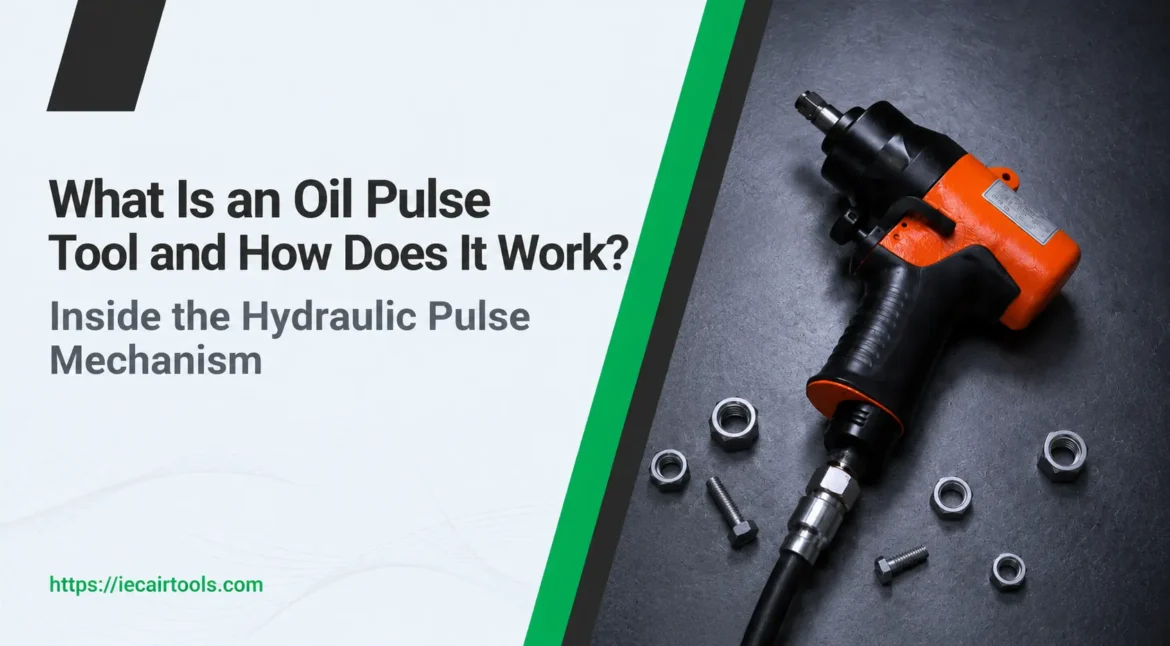
An oil pulse tool uses compressed air to generate torque through a hydraulic pulse mechanism. The basic system combines an air motor with a hydraulic pulse unit, allowing the tool to deliver high torque in short pulses rather than through the repeated mechanical impacts used by a conventional impact wrench.
That difference affects how the tool behaves during fastening. It influences torque delivery, reaction forces, vibration, noise and operator handling, which is why oil pulse technology is widely used for repetitive fastening applications.
What Happens Inside an Oil Pulse Tool?
The process begins with compressed air entering the tool and driving its air motor. The motor produces rotary motion, which is transferred to the hydraulic pulse unit.
Inside the pulse unit, hydraulic pressure builds and releases in rapid cycles. The resulting pulses transfer torque to the output spindle and, ultimately, to the fastener.
IEC’s Accura Oil Pulse Wrenches use a double-chamber air motor and hydraulic pulse unit, with a double-blade pulsing mechanism designed for balanced torque generation. The range covers applications from 9 to 550 Nm, depending on the model.
| Component | Function |
| Air motor | Converts compressed air into rotary motion |
| Hydraulic pulse unit | Generates the torque pulses |
| Oil | Transfers hydraulic pressure within the pulse unit |
| Pulse mechanism | Delivers torque to the output |
| Output spindle | Transfers torque to the fastener |
How the Hydraulic Pulse Generates Torque
The hydraulic unit creates pressure as the rotating mechanism moves through each pulse. That pressure transfers torque to the output spindle before the cycle repeats.
This hydraulic method eliminates the metal-to-metal impacting found in conventional impact mechanisms. IEC identifies this as one of the main characteristics of its Accura Oil Pulse technology, along with reduced noise and vibration and improved operator comfort.
The result is a compact pneumatic fastening tool capable of delivering substantial torque while maintaining a different operating feel from an impact wrench.
Joint behaviour still matters. IEC recommends assessing joint conditions and operating the tool at its rated working pressure when selecting and using an oil pulse tool.
What the Operator Experiences
The hydraulic pulse mechanism has a direct effect on the way the tool feels in the operator’s hands. IEC’s Accura Oil Pulse Wrenches are designed around low reaction characteristics. The range also includes a rubber grip and throttle adjustment to support handling during fastening.
Operator exposure matters when fastening is repeated throughout a shift. Research from the European Agency for Safety and Health at Work identifies hand-arm vibration as a relevant physical hazard in maintenance work and discusses health effects associated with prolonged exposure to vibrating tools.
Oil Pulse Tools and Impact Wrenches
Both tools use compressed air, but their torque-generation mechanisms are different.
| Feature | Oil Pulse Tool | Impact Wrench |
| Torque mechanism | Hydraulic pulse | Mechanical impact |
| Torque delivery | Hydraulic pulses | Impact blows |
| Reaction characteristics | Low reaction | Higher impact reaction |
| Noise and vibration | Lower characteristics | Typically higher |
| Typical role | Repetitive assembly fastening | High-torque and rapid fastening |
This difference makes the oil pulse tool particularly relevant where operators perform repeated fastening operations and the physical behaviour of the tool matters alongside its torque capability. IEC’s Accura Oil Pulse Wrenches are available across a broad range of bolt sizes and torque requirements.
Joint Conditions Affect Torque Delivery
The joint itself influences how an oil pulse tool performs. A hard joint reaches resistance quickly as the fastener approaches seating. A softer joint allows more rotation before the required torque is reached. Friction, fastener condition and joint construction can also affect the tightening behaviour.
IEC therefore recommends assessing joint conditions before selecting a pulse tool. Its Accura range is designed for accurate tightening across both hard and soft joints, with torque adjustment available through an Allen key without dismantling the tool.
For production applications, the model should be selected around the required torque range, joint behaviour and working conditions.
Where Shut-Off Adds Another Layer of Control
An oil pulse mechanism can also be combined with automatic shut-off. IEC’s Accura Oil Pulse Shut-Off Wrenches automatically stop when the preset torque is reached and cut the air supply to the motor. The range also specifies zero torque reaction at shut-off.
This changes the end of the fastening cycle: the tool provides a defined stopping point rather than continuing to run after the preset torque has been achieved.
Limited Air Pressure and the N Series
Air supply remains important because the air motor still depends on the pneumatic system. IEC’s Accura Pulse N Series Wrenches are specifically designed for fastening applications where compressed-air pressure is limited or below the rated working pressure. The series includes models such as the IAP-8N and IAP-10N for heavier-duty applications.
This makes air pressure part of tool selection alongside torque, joint conditions and fastening requirements.
Keeping the Pulse Mechanism Working Properly
Oil pulse tools depend on the condition of both the pneumatic supply and the hydraulic pulse unit. IEC recommends clean, dry air, correctly sized hoses and couplers, compatible impact sockets and operation at the tool’s rated working pressure.
The oil inside the pulse unit also requires attention. IEC offers the IAP-OF-300 oil filler specifically for maintaining its Accura Pulse tools.
Where Oil Pulse Technology Fits
The right oil pulse tool starts with three things: the joint, the required torque and the operator’s working conditions. Once those are understood, the choice between standard pulse, shut-off and other fastening technologies becomes much clearer.
FAQs
1. What is an oil pulse tool?
An oil pulse tool is a pneumatic fastening tool that uses a hydraulic pulse unit to generate and transfer torque to a fastener.
2. How does an oil pulse tool work?
Compressed air drives an air motor, which drives the hydraulic pulse unit. The unit builds and releases hydraulic pressure in rapid cycles to deliver torque pulses to the output spindle.
3. What does the oil do in a pulse tool?
The oil acts as the hydraulic medium inside the pulse unit, allowing pressure to build and transfer torque through the pulse mechanism.
4. What is the difference between an oil pulse tool and an impact wrench?
An oil pulse tool generates torque hydraulically, while an impact wrench uses mechanical impact. This produces different characteristics in reaction, vibration, noise and operator handling.
5. Are oil pulse tools suitable for repetitive assembly?
Yes. Their low-reaction characteristics, ergonomic design and high power-to-weight ratio make them suitable for many repetitive fastening applications. IEC’s Accura range covers a broad range of torque requirements.
6. Do oil pulse tools measure torque?
A conventional oil pulse tool provides adjustable torque within its specified range but does not directly provide the same cycle-level torque measurement as a transducerised fastening system. IEC’s Accura FT Transducerised Pulse Tools are designed for applications where torque control and measurement are a priority.