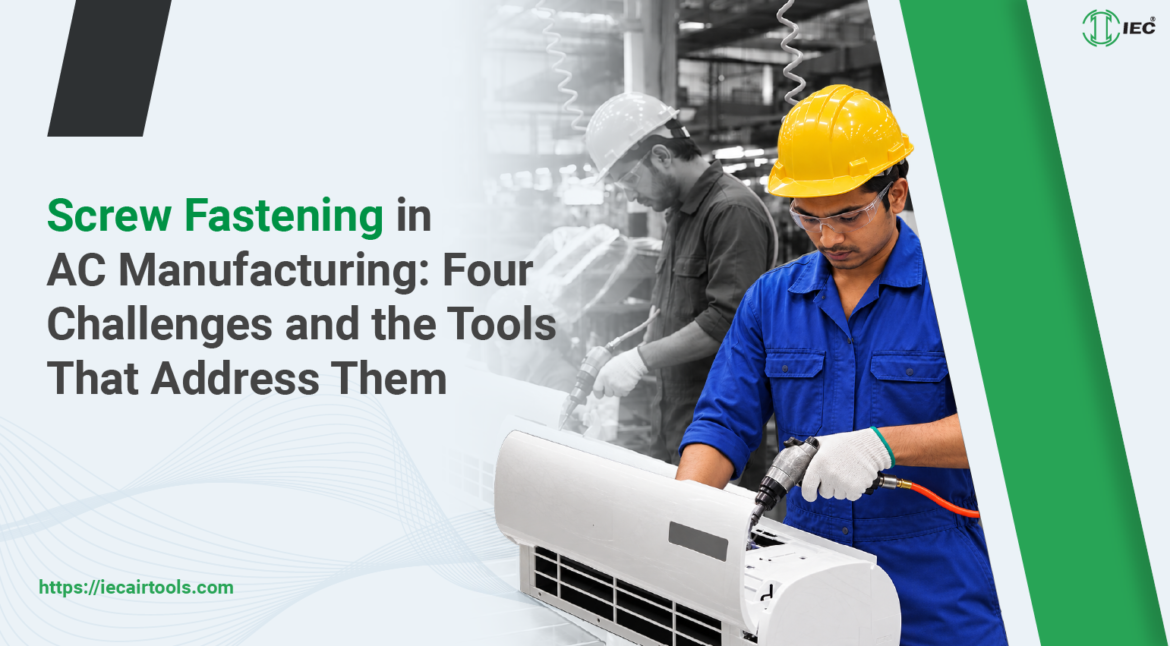
The summer sales season may determine when air conditioners leave retail shelves, but production has to prepare for it months earlier.
From October, manufacturers usually plan for inventory and securing components ahead of the summer rush. This seasonal lead time makes the final months of the year important for production planning, even when retail demand is still months away. Fortune India explains the long lead times and advance procurement involved in India’s AC industry.
The industry is also preparing for renewed growth. ICRA projects India’s room AC volumes to rise by 12 to 14% in FY2027, reaching 12.6 to 12.9 million units. As production plans respond to this outlook, the demands placed on assembly operations become worth examining. One place to start is the repetitive screw-fastening work that brings sheet-metal panels and brackets together.
Screw Fastening on the Air Conditioner Assembly Line
Sheet-metal assembly depends on fastening operations that must hold components together without damaging the material or the threads. The challenge is that different joints can respond differently to the same driving action. Screw type, sheet thickness and joint construction all influence how the fastener needs to be driven.
The implications become clearer when we look at what can go wrong at the joint, and how the screwdriver mechanism can help address it.
Four Fastening Challenges in AC Sheet-Metal Assembly
1. Thin Sheet Metal Leaves Little Margin for Error
Sheet metal offers limited material thickness for thread engagement compared with a thicker component. If a screw is driven too far, its threads or the surrounding material can be damaged. If tightening is insufficient, the joint may not achieve its required holding strength.
A torque-controlled shut off screwdriver stops driving when the preset torque is reached. This gives the operation a defined stopping point rather than leaving the screw to turn indefinitely. IEC’s published models cover two torque ranges:
- IS-4TC/P:5–2.8 Nm | M5 screw capacity | 0.7 kg
- IS-5TC/P:5–5.2 Nm | M6 screw capacity | 1.1 kg
The appropriate model depends on the specified torque and the fastening application’s requirements.
2. Self-Tapping Screws Need a Different Driving Approach
Unlike screws that enter a pre-formed thread, self-tapping screws form or cut their mating threads as they are driven into the material. The tool must deliver the driving action needed for the screw to engage without compromising the joint.
- IEC’s pneumatic impact screwdrivers include models for M5, M6 and M8 screw capacities. Their suitability depends on the fastener, material thickness and application requirements.
3. Repeated Tightening Can Lead to Over-Driving
When the screw reaches its seated position, continued driving can damage the threads or the material around the fastening point. This risk matters in repetitive operations, where the same task is performed across multiple units.
- A slip clutch screwdriver disengages the drive when the clutch setting is reached. The mechanism helps limit continued driving, provided the clutch is correctly set for the application.
- IEC’s slip clutch range includes M4 and M5 screw capacities across straight, pistol and angular configurations. Models vary in weight and length to suit different handling and access requirements.
4. Repeated Fastening Puts Demands on the Operator and Tool
A production line may repeat the same fastening operation thousands of times across a shift. Repeatedly activating the tool can add to operator effort over the course of a run.
IEC’s torque-controlled shut off screwdrivers feature axial-push auto-start. The tool starts when the operator presses it forward against the screw, eliminating the need to manually press a separate lever for each cycle. This simplifies tool activation during repetitive assembly work.
Matching Tool Control to the Joint
The four challenges point to a broader selection principle: a screwdriver should be chosen for the fastening operation it needs to perform, rather than on speed or screw capacity alone.
Torque-controlled shut off tools provide a defined stopping point at a preset torque. Slip clutch tools disengage the drive at the clutch setting. Impact screwdrivers provide a different driving mechanism for applications suited to that tool type. Where fastening positions or approach angles constrain access, IEC’s Fiam range of straight and angled automatic shut off screwdrivers adds another configuration to consider.
The final choice still depends on the actual joint specification. Torque requirements, screw dimensions, material thickness, access and the required level of process control must be assessed together. A tool’s published screw capacity or torque range is a starting point for selection, not a substitute for application validation.
Building Reliability Across White Goods Manufacturing
As India’s white goods industry expands, fastening decisions remain part of the engineering behind every dependable assembly. IEC Air Tools brings its legacy in industrial fastening solutions to these production requirements, where the right combination of tool mechanism, control and application fit helps manufacturers build processes suited to sustained production.