Quick Summary
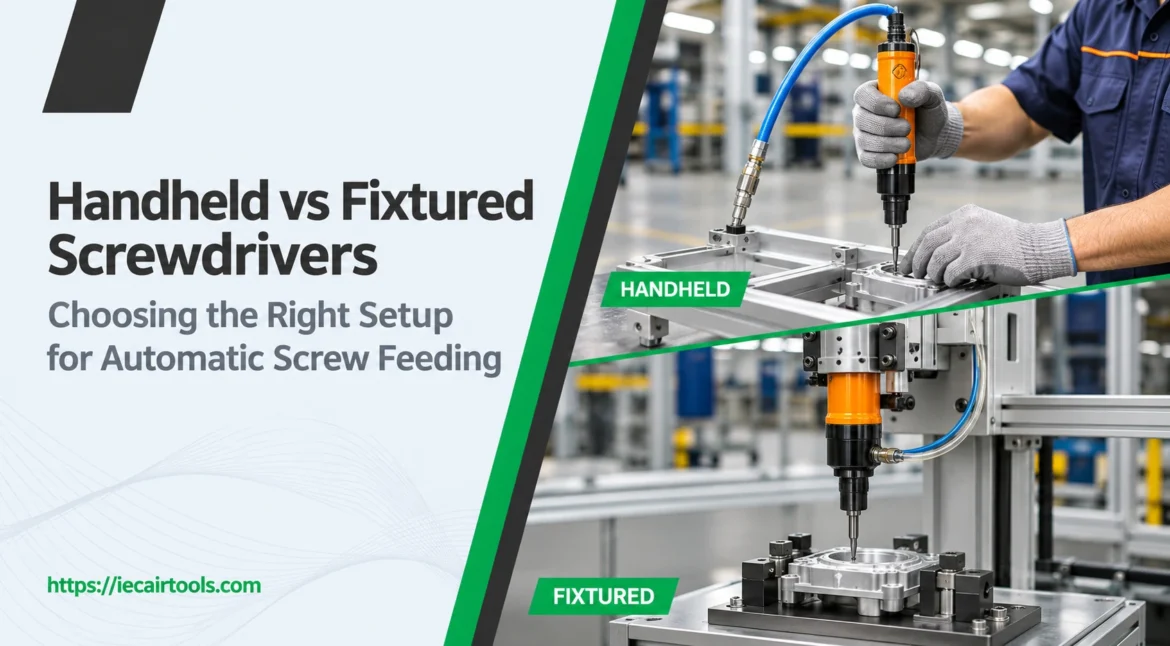
In automatic screw feeding, the feeder delivers each screw to the screwdriver. With a handheld setup, the operator guides the tool between joints. With a fixtured setup, a slide, axis system or robot positions the tool and drives the screw. The right choice depends on joint positions, product variety, production volume and part location accuracy.
In one assembly station, an operator guides a screwdriver from joint to joint as screws arrive automatically. In another, a mounted tool moves to each fastening point and drives the screw as part of a programmed cycle.
Both setups use automatic screw feeding. What changes is how the screwdriver reaches the joint, which affects how the station is designed and operated.
What Stays the Same: The Screw Arrives Automatically
In both setups, a feeder sorts loose screws, separates them one at a time and delivers them to the screwdriver, usually through a feed hose. The operator does not need to pick up each screw manually.
The difference is how the tool reaches the fastening point. For more detail on screw delivery methods, see our guide to Screw Feeders Explained: Blow-Feed vs Pick-and-Place.
Handheld Screwdrivers: The Operator Guides the Tool
With a handheld screwdriver and automatic feeding, the operator positions the tool at each joint while the feeder supplies the screws. Once the tool is correctly positioned and pressed against the part, the screwdriver drives the screw.
IEC Air Tools also offers a range of handheld screwdrivers, including slip-clutch, shut-off, eTensil brushless and impact screwdrivers. , catering to different fastening requirements. The choice depends on the joint, the required tightening control and the application.
The tool may be supported by an arm or balancer to reduce the effort required to hold it. Depending on the setup, it can also be used at different angles and orientations.
Where it fits well:
- Stations with joints in different positions or orientations
- Production lines handling frequent product changes
- Parts that are difficult to locate in a fixed, repeatable position
- Applications where a fully fixtured setup is not justified
What to consider: The operator still controls tool placement. Reach, tool balance, and handle position affect comfort and consistency, particularly across long shifts. The station should allow access to every fastening point without awkward movements.
Fixtured Screwdrivers: The Machine Positions the Tool
A fixtured screwdriver is mounted on a mechanism rather than held by an operator. It may move along a fixed slide to reach one joint, use an axis system to reach multiple joints, or be carried by a robot.
The machine positions the tool and drives the screw according to the station’s setup. Depending on the application, the operator may load and unload the part while the fastening cycle runs automatically.
Where it fits well:
- High-volume production with repeatable joint positions
- Applications with demanding cycle-time targets
- Assemblies requiring consistent tool positioning across repeated cycles
What to consider: The part must be located accurately so the programmed tool position aligns with the joint. The fixture must also provide sufficient clearance around the fastening point. If the station handles multiple product variants, the required changes must be accounted for in its tooling or programming.
Handheld vs Fixtured Screwdrivers at a Glance
| Consideration | Handheld | Fixtured |
| Who moves the tool? | Operator | Slide, axis system or robot |
| Who positions the tool? | Operator | Machine follows its configured positions |
| Typical application | Flexible stations with varied joint positions | Repetitive stations with fixed joint positions |
| Main requirement | Comfortable reach and tool handling | Accurate, repeatable part location |
| Product changes | Generally easier to accommodate | May require tooling or programming changes |
Both setups can use automatic screw feeding. The choice depends on the work the station needs to perform, not simply on its level of automation.
Choosing the Right Setup
Before choosing between handheld and fixtured screwdrivers, consider four factors.
1. Joint positions and accessibility
Handheld tools suit assemblies where joints are spread across different positions or angles. Fixtured tools work well when the joints can be reached through a defined, repeatable movement.
2. Product variety
Frequent product changes often favour handheld tools because the operator can adapt to different joint locations. Fixtured systems can also handle variants, but may require suitable tooling or programmed movements.
3. Production volume and cycle time
For repetitive, high-volume production, fixtured screwdrivers can reduce manual tool movement and support consistent cycle times. Handheld systems may be more practical when production requirements do not justify a dedicated fixture or automated station.
4. Part location accuracy
A fixtured screwdriver relies on the joint being in the expected position. If the part cannot be located consistently, the station may need better fixturing or a different approach. A handheld tool gives the operator more flexibility to accommodate variations in joint position.
Some production lines use both setups, placing handheld tools at flexible assembly stations and fixtured tools where fastening positions and production cycles are more predictable.
Tightening Quality in Either Setup
Automatic screw feeding handles screw delivery, but it does not by itself confirm that a joint has been tightened correctly. Depending on the screwdriver and control system, the process can monitor tightening parameters, check depth where supported, and report an OK/NOK result. These checks help identify fastening issues whether the tool is handheld or fixtured.
How IEC Supports Automatic Screwdriving
IEC Air Tools provides screw feeding and tightening systems, including feeding systems, handheld screwdrivers with automatic feeding and fixtured screwdrivers.
The appropriate setup depends on joint positions, part location, product variety and production requirements. Considering screw feeding and tool movement together helps manufacturers select a configuration suited to the actual assembly process.
Frequently Asked Questions
1. What is a handheld screwdriver with automatic feeding?
It is a screwdriver guided by an operator, with screws delivered automatically to the tool by a feeder. The operator positions the tool but does not need to pick up each screw manually.
2. What is a fixtured screwdriver?
A fixtured screwdriver is mounted on a slide, axis system or robot. The mechanism positions the tool at the fastening point and drives the screw.
3. Does automatic screw feeding position a handheld screwdriver?
No. The feeder delivers the screw to the tool, but the operator guides the screwdriver to the joint.
4. When should I choose a fixtured screwdriver?
Consider one when production is repetitive, joint positions are predictable, cycle-time requirements are demanding and the part can be located accurately.
5. Can handheld and fixtured screwdrivers use automatic screw feeding?
Yes. Both setups can receive screws from a feeder. The difference is how the screwdriver moves to the fastening point.
6. Can tightening be monitored in both setups?
Yes, if the screwdriver and control system support the required checks. Depending on the system, these may include tightening parameters, depth monitoring and OK/NOK results.