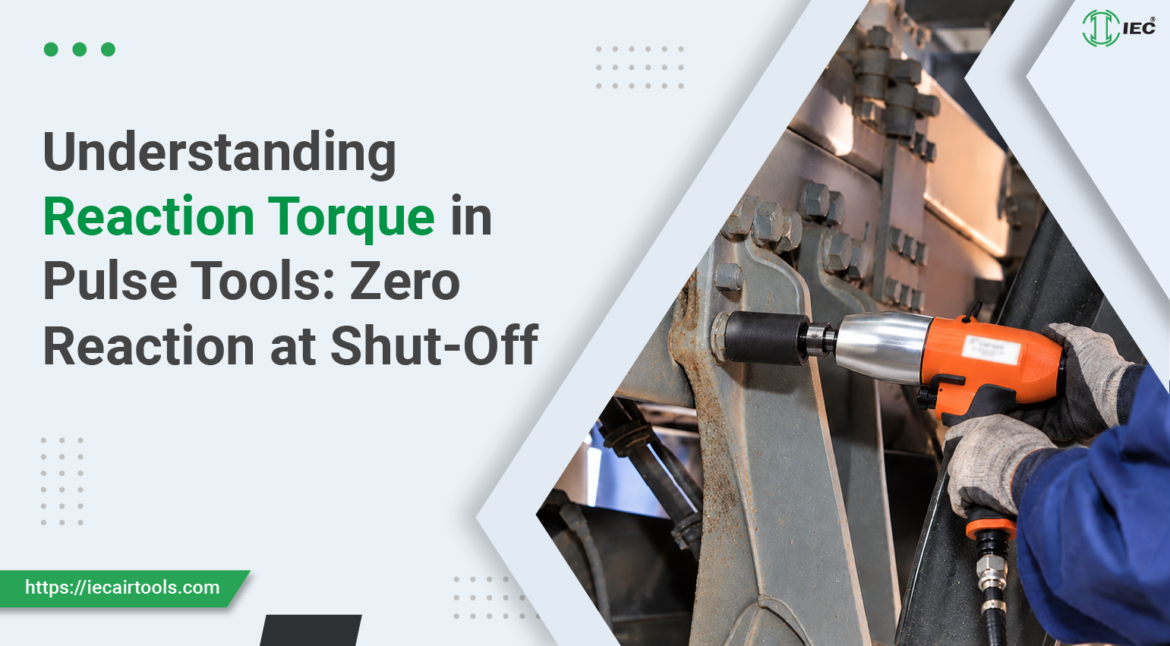
When a fastener reaches its target torque, the tool stops. For the operator holding it, the tightening cycle has involved more than turning a bolt. The tool has also exerted a reaction force against the hand.
This is reaction torque. During repetitive fastening, the force transmitted back through a handheld tool becomes part of every cycle an operator performs. Its effect depends on the tool, the joint and how quickly torque builds and stops.
That makes the end of tightening worth examining. What happens in the final moments of a cycle, and how does a shut-off pulse tool change what the operator feels?
Every Tightening Cycle Pushes Back on the Operator
When a powered tool turns a fastener, an opposing torque acts on the tool body. The operator holding it must resist that reaction to keep the tool under control.
The size of the reaction is only part of the equation. Its timing matters too. Torque reaction time describes the interval over which the reaction develops, from the onset of torque to the point at which the tool shuts off. A rapid rise can demand a different muscular response from a more gradual one.
The finding helps explain why the tightening cycle cannot be assessed by torque output alone. How that torque reaches the joint, and how the tool stops, also affect the operator’s physical response.
Why the End of the Cycle Matters
Joint stiffness influences how quickly a fastener develops resistance as it tightens. A hard joint, such as a metal-to-metal connection with little compression, can reach its target torque over a short angle of rotation. A softer joint, which may include a gasket or other compressible material, generally requires more rotation as the joint settles.
These differences affect the tightening profile and the reaction experienced by the operator. Tool selection matters here: an unsuitable tool or an inconsistent air supply can change the way torque develops.
Another study examined reaction torque, muscle activity and perceived exertion while operators used powered nutrunners under different conditions. Their findings linked larger reaction impulses with worse operator ratings. Softer joints and underpowered tools produced larger impulses in the tested conditions.
The practical implication is not that every soft joint is more difficult to tighten. It is that joint behaviour, tool capability and shut-off characteristics need to be considered together when assessing reaction torque.
How a Pneumatic Pulse Tool Changes Torque Delivery
A pneumatic pulse tool uses an air motor to drive a hydraulic pulse unit. The pulse unit transfers torque to the fastener through a series of hydraulic pulses.
This changes how tightening torque is delivered to the fastener. The hydraulic mechanism is designed to reduce reaction torque, noise and vibration, helping improve operating comfort during repetitive fastening.
IEC’s Accura oil pulse range is designed for accurate tightening across hard and soft joints, with torque adjustment available to suit the application. The correct model still depends on the joint, the required torque and the production conditions.
For a closer look at the mechanism, see What Is an Oil Pulse Tool and How Does It Work?
The product range is detailed here: Accura Oil Pulse Wrenches.
What Shut-Off Adds: Zero Reaction at the End of Tightening
A pulse mechanism reduces reaction during torque delivery. A shut-off pulse tool adds another function: it automatically stops the air supply when the preset torque is reached.
IEC’s Accura ST+ shut-off pulse wrenches use a pressure-sensing mechanism to detect the preset condition and cut air to the motor. Zero torque reaction at shut-off allows single-handed operation without a reaction arm under the intended application conditions.
The benefit comes from how the shut-off mechanism ends the cycle. The ST+ range covers torque adjustment from 8 to 110 Nm across its models. Selection should account for the required torque, joint behaviour and the specific tool’s operating range.
For more detail, see The Role of Shut-Off Pulse Tools in Building Low-Defect, High-Speed Assembly Lines.
Product details: Accura Oil Pulse Shut-Off Wrenches (ST+).
Where Zero Torque Reaction at Shut-Off Matters Most
The benefit is particularly relevant in three situations:
● High-volume assembly: Repeated fastening makes reaction characteristics an important part of workstation design.
● Restricted access: Where bracing against the tool is difficult, eliminating reaction at shut-off can make handling easier.
● Repetitive tightening on varied joints: Tool selection needs to account for joint behavior, torque requirements and the way the tool shuts off.
The right choice depends on the complete fastening application, not torque range alone.
Related reading: When Fastener Access Becomes an Assembly Challenge.
How IEC Supports Low-Reaction Fastening
Across the Accura range, low-reaction pulse tightening comes in three forms:
● Accura Oil Pulse wrenches: hydraulic pulse tightening from 8 to 550 Nm, designed to reduce reaction, noise, and vibration across hard and soft joints.
● Accura ST+ shut-off pulse tools: Covering 8–110 Nm across the range, these tools automatically shut off at preset torque and provide zero torque reaction at shut-off, as specified by IEC.
● Accura FT transducerised pulse tools: Add transducer-based torque measurement, torque validation and OK/NOK results through the CMS FT-V2 controller, supporting applications that require fastening traceability.
The distinction is straightforward: consider ST+ when automatic shut-off and zero reaction at shut-off are priorities; consider FT when the process also requires measured torque and recorded results.
Product details: Accura FT Transducerised Pulse Tools.